CertiFlyers Certificate of Completion
Jordan Lee Foreign Object Debris (FOD) Scan to verify → Stay current. Stay airworthy.
Every zone of the aircraft. Every technician trained.
Video-led safety courses built on the regulation or standard each one teaches. A certificate for every technician, and one record for the whole team.


Certificate check
Valid
This certificate is genuine and current.
- Technician
- Jordan Lee
- Course
- Foreign Object Debris (FOD)
- Company
- Example MRO
- Certificate
- CF-2026-000412
Checked live against the CertiFlyers record.
An inspector scans the QR code and sees at once whether the certificate is current. No binder, no phone calls.
For managers
Retire the sign-in binder
Drag across the picture: the same team's training on paper, then in CertiFlyers.
Example 2 of 4 complete
Team training record
Hangar 2 · 4 people · Example
M. AlvarezConfined Space EntryCompleteQR ✓
J. ChenFall PreventionIn progress—
S. OkaforHuman Factors PrimerCompleteQR ✓
R. PatelRespiratory ProtectionNot started—
Every certificate can be checked by scanning its QR code.
TRAINING ATTENDANCE — HANGAR 2
NAMECOURSEDATESIGN
M. AlvarezConfined space3/14〜
J. ChenFall protect.??
S. OkaforHuman factors5/2〜
R. PatelResp. fit testexpired?
PAPER BINDER
CERTIFLYERS
Binder CertiFlyers
How it works
From assignment to audit
Scroll through the four steps, or pick one under the screen.
01
Assign
Choose courses for one person, a team or the whole hangar, and assign them on the website with a due date. Seats are per person, from one to 50 and more.
02
Train
Each CertiFlyers course is a narrated video, a slide deck and a quiz, on the web or the iPhone and Android app, between jobs or at home.
03
Certify
A pass issues a certificate with the person's name, the course and a QR code.
04
Audit
An inspector scans the QR code and sees that the certificate is valid. For an audit, export the team record or an audit pack. No binder, no phone calls.
Example
Assign a courseManager view
CourseAircraft Confined Space & Fuel Tank Entry Procedures
✓M. Alvarez
✓J. Chen
✓S. Okafor
✓R. Patel
Assign to 4 people
Example
Aircraft Confined Space & Fuel Tank Entry Procedures
✓Video
✓Slides
●Quiz
Continue to quiz
Example
Certificate of completion
M. Alvarez
has completed
Aircraft Confined Space & Fuel Tank Entry Procedures
Reference: OSHA 29 CFR 1910.146
Example certificate
Example
certiflyers.com/verify
✓ Valid certificate
NameM. Alvarez
CourseAircraft Confined Space & Fuel Tank Entry Procedures
Issued byCertiFlyers
Try it now
Three questions from real courses
No sign-up. Each answer shows the reference behind it.
Question 1 of 3 · From Aircraft Confined Space & Fuel Tank Entry Procedures · OSHA 29 CFR 1910.146
An entrant working inside a fuel tank stops answering the Attendant's radio calls and tapping signals. The Attendant is alone at the opening and has not been trained or equipped for rescue. What does the Attendant do?
A. Climb in at once to pull the entrant out.
Not quite. The Attendant may enter only when relieved by another attendant and trained and equipped for rescue, and this Attendant is neither.
B. Ask a nearby co-worker to go in while the Attendant watches.
Not quite. Rescue is for trained rescue personnel, and National Institute for Occupational Safety and Health (NIOSH) data show more than 60% of confined space fatalities are would-be rescuers rather than the original entrant.
C. Keep calling for a few more minutes before raising the alarm.
Not quite. The Attendant's role when an entrant goes down is to summon trained rescue personnel immediately.
D. Stay outside and summon trained rescue personnel immediately.
Correct. OSHA 29 CFR 1910.146 prohibits the Attendant from entering unless relieved by another attendant and trained and equipped for rescue, so the Attendant summons trained rescue at once.
Question 2 of 3 · From Aircraft Maintenance Documentation · 14 CFR 43.9, 43.11, 91.417 and Part 39
After replacing a nose landing gear shock strut seal, a technician drafts the entry "Replaced strut seal per manufacturer data" and signs below it. What must the entry still contain before it is complete?
A. The completion date, the exact data reference such as the manual chapter, the performer's name, and certificate number and kind.
Correct. 14 CFR 43.9 requires the work description or a specific data reference, the date of completion, the performer's name, and the approver's signature, certificate number and kind of certificate.
B. An airworthy or unairworthy statement, because every maintenance entry needs one.
Not quite. that statement is what 14 CFR 43.11 adds for inspection entries; it is not one of the four 43.9 elements.
C. Nothing more, because the signature already approves the aircraft for return to service.
Not quite. a signature approves return to service only for the specific work documented, and an incomplete entry carries the same legal consequence as not performing the work at all.
D. Only the certificate number, since "per manufacturer data" is an acceptable reference.
Not quite. the course says a vague reference such as "per manufacturer data" does not satisfy 14 CFR 43.9; the entry must identify the exact data, such as a manual chapter.
Question 3 of 3 · From Fall Prevention · OSHA 29 CFR 1910 Subpart D and 1910.140
A technician must reach a component on top of the fuselage. The work surface has an unprotected edge about 8 feet above the hangar floor, and the job will take only a few minutes. What comes first?
A. Skip fall protection, since the task is short.
Not quite. Fall protection is generally required at or above 4 feet where unprotected edges exist, regardless of task duration.
B. Try ground-based work first, and if that fails, use a stand with guardrails on all open sides.
Correct. The hierarchy of controls puts elimination first and engineering controls such as guardrails before personal protective equipment (PPE), so ground-based work and a guarded platform come before a harness.
C. Put on a harness and tie off to the nearest piece of structure.
Not quite. PPE is the last resort in the hierarchy of controls, and a PFAS connects to an approved anchorage point, not to whatever structure is nearest.
D. Work from the fuselage carefully, staying well back from the edge.
Not quite. Technicians never work on unprotected elevated surfaces 4 feet or higher without mitigating the hazard, and they disengage and notify the supervisor if the task cannot be done safely.
Course catalog
Courses for the hangar floor
Tap a card to flip it: the reference, the format and the price are on the back.
-
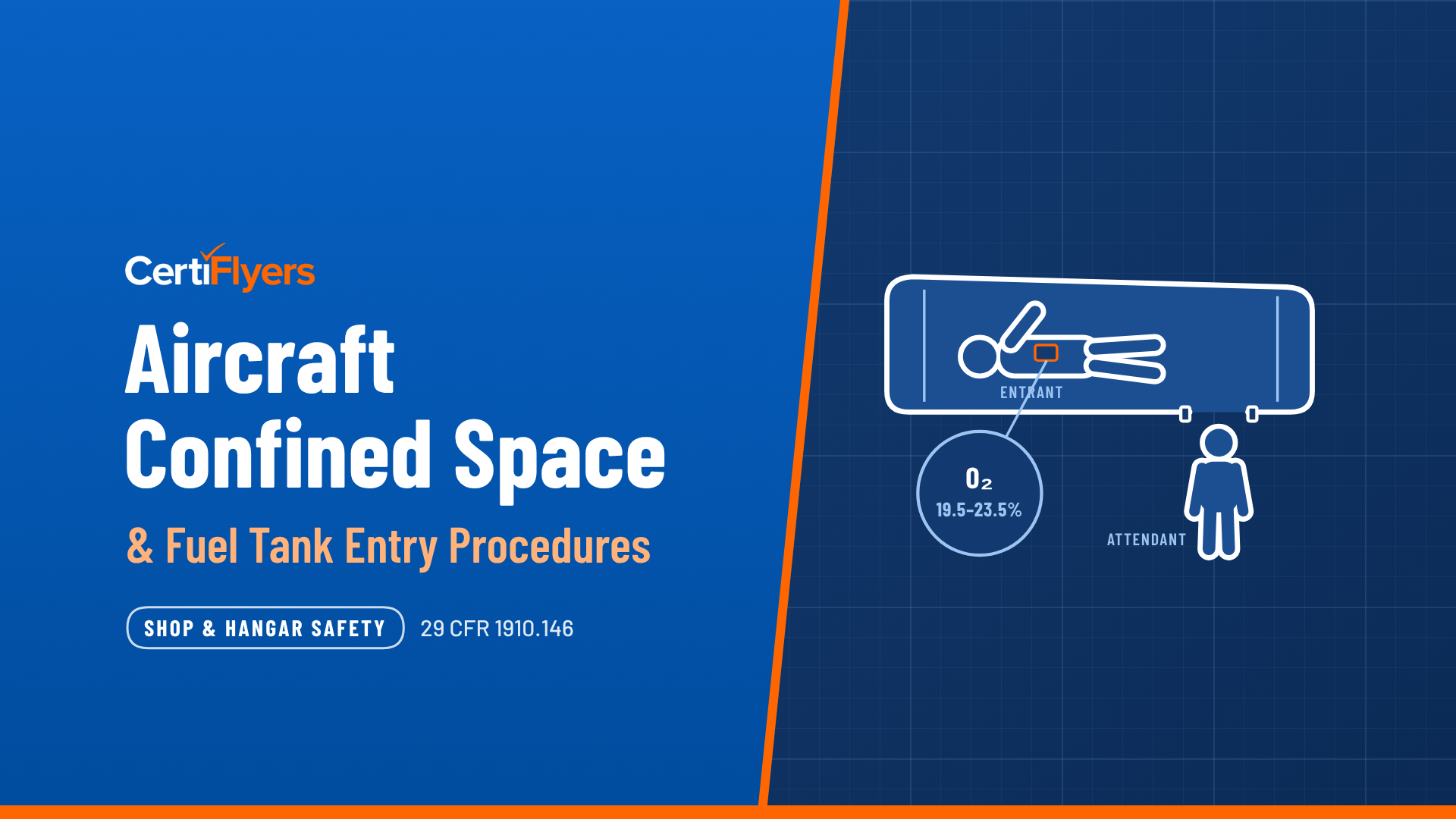 Shop & Hangar Safety Aircraft Confined Space & Fuel Tank Entry Procedures Tap for details Shop & Hangar Safety Aircraft Confined Space & Fuel Tank Entry Procedures No posted permit, no Attendant outside: don't break the plane.
-
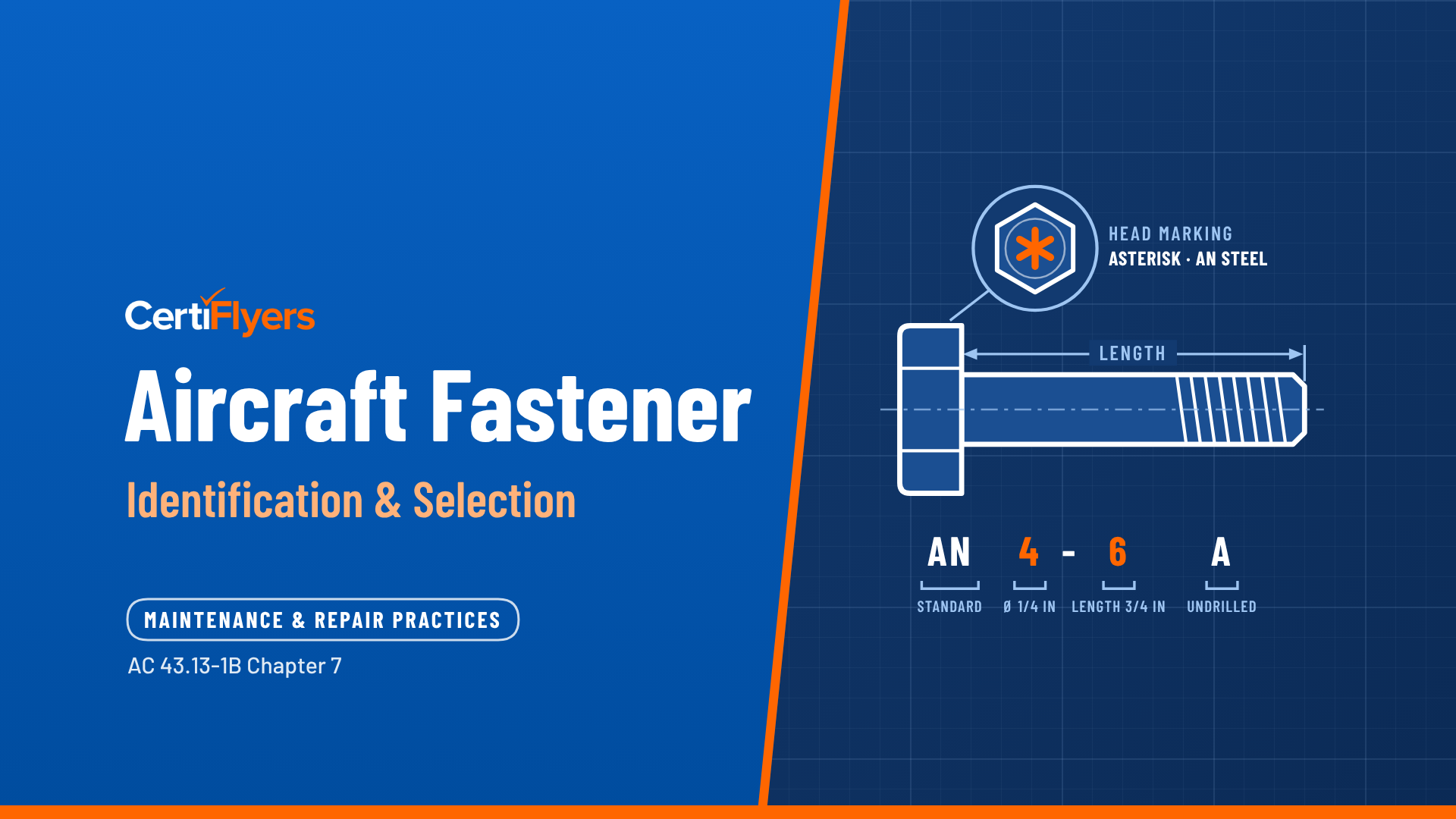 Maintenance & Repair Practices Aircraft Fastener Identification and Selection Tap for details Maintenance & Repair Practices Aircraft Fastener Identification and Selection Same diameter is not the same bolt: match the full part number.
-
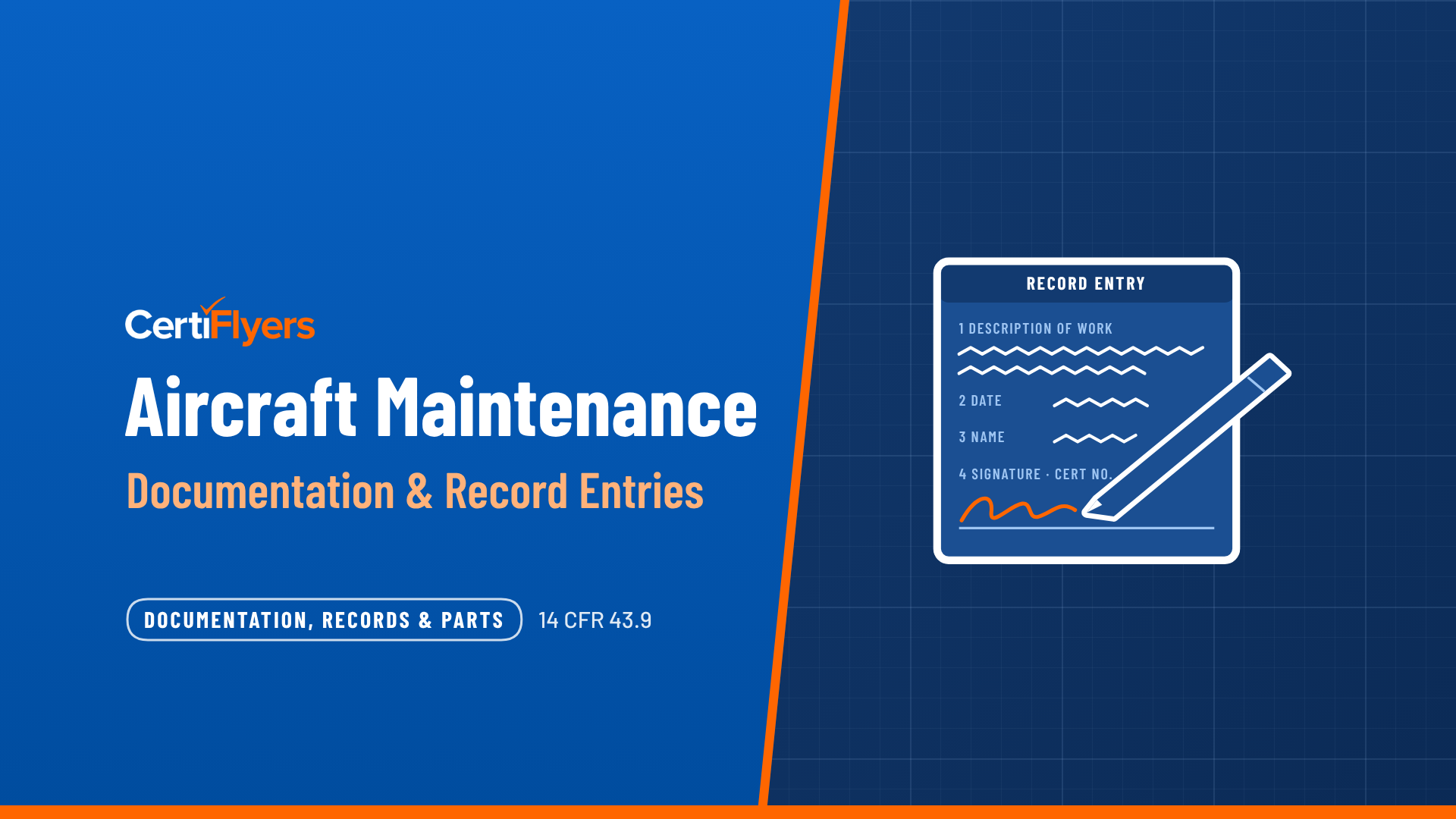 Documentation, Records & Parts Aircraft Maintenance Documentation Tap for details Documentation, Records & Parts Aircraft Maintenance Documentation An incomplete entry carries the same legal consequence as work not done.
-
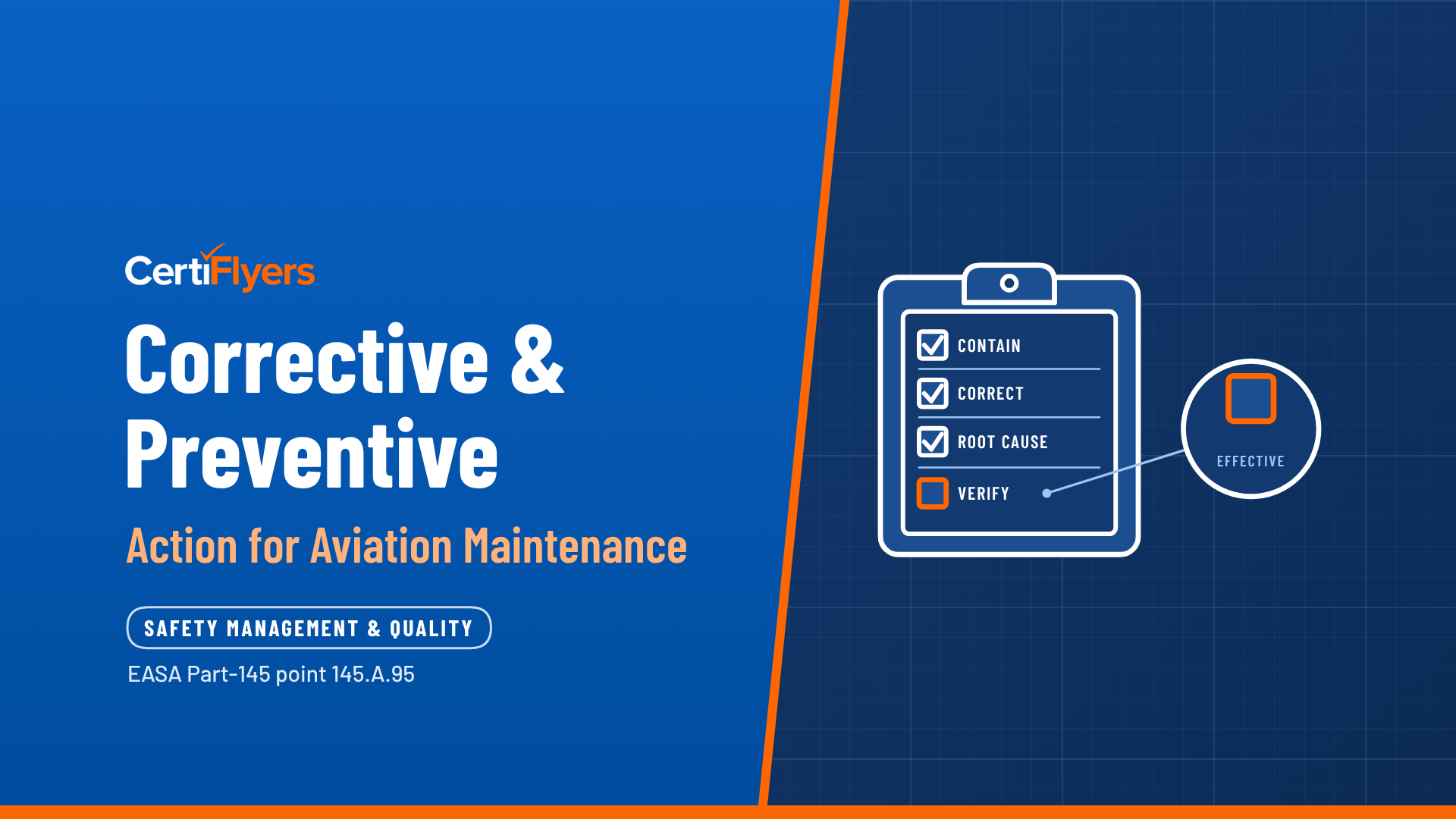 Safety Management & Quality Corrective and Preventive Action Tap for details Safety Management & Quality Corrective and Preventive Action Contain first, remove the cause, and prove the fix worked before closing.
-
 Shop & Hangar Safety Eye and Face Protection Tap for details Shop & Hangar Safety Eye and Face Protection Match the eyewear to the hazard: no Z87 mark, no use.
-
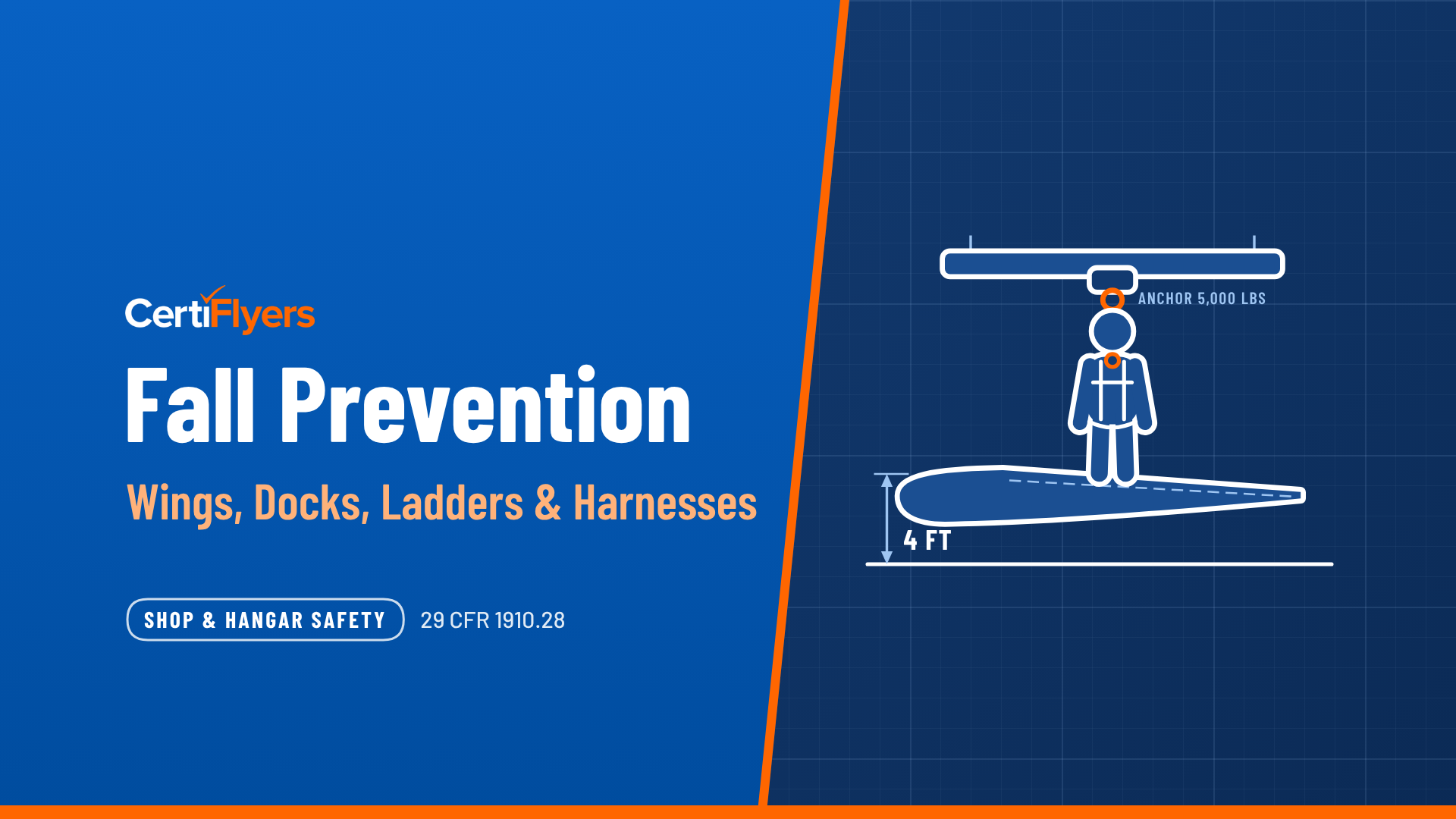 Shop & Hangar Safety Fall Prevention Tap for details Shop & Hangar Safety Fall Prevention From four feet up, guardrails come first and the harness comes last.
-
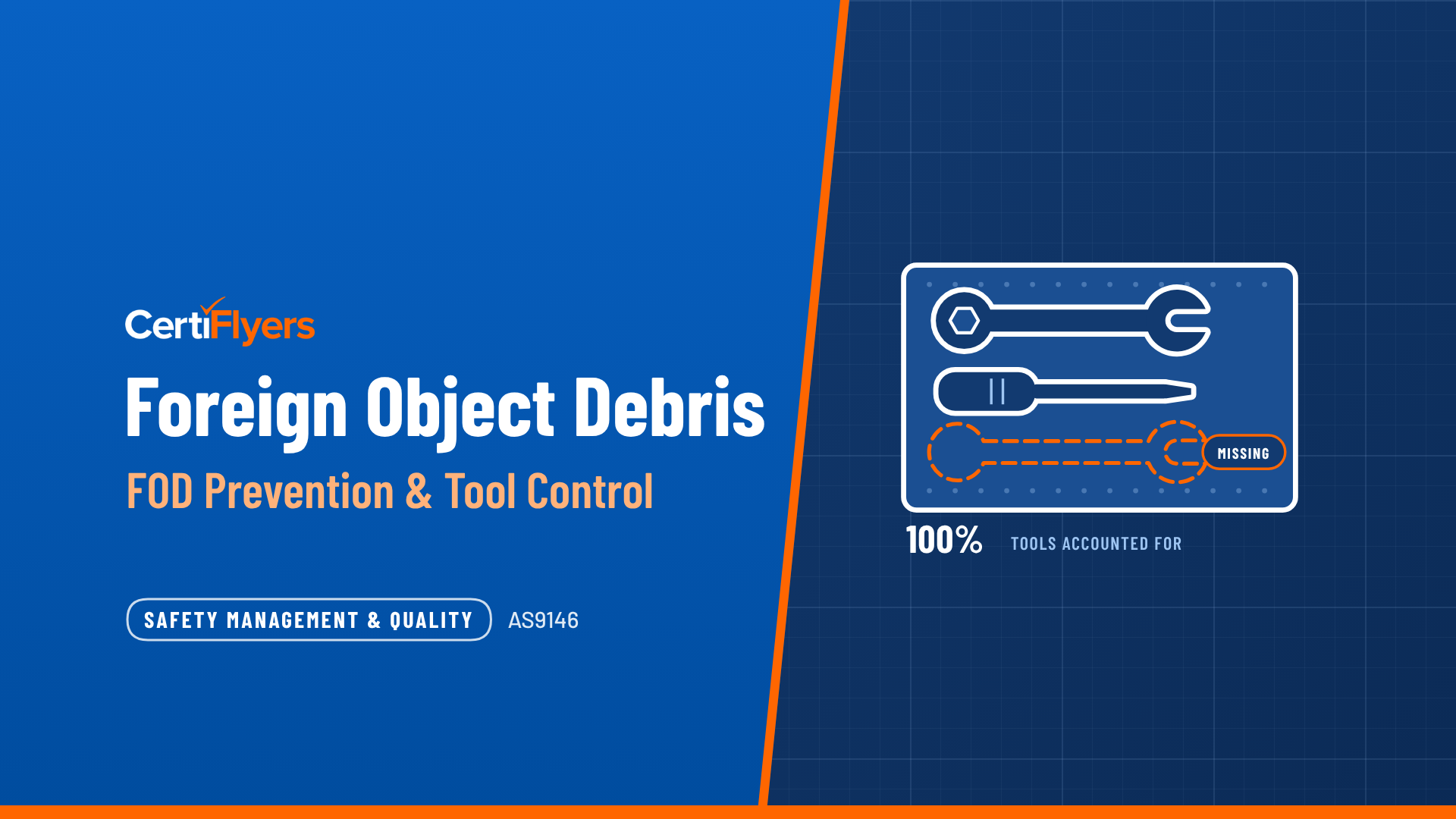 Safety Management & Quality Foreign Object Debris (FOD) Tap for details Safety Management & Quality Foreign Object Debris (FOD) Clean as you go; no panel closes until everything is accounted for.
-
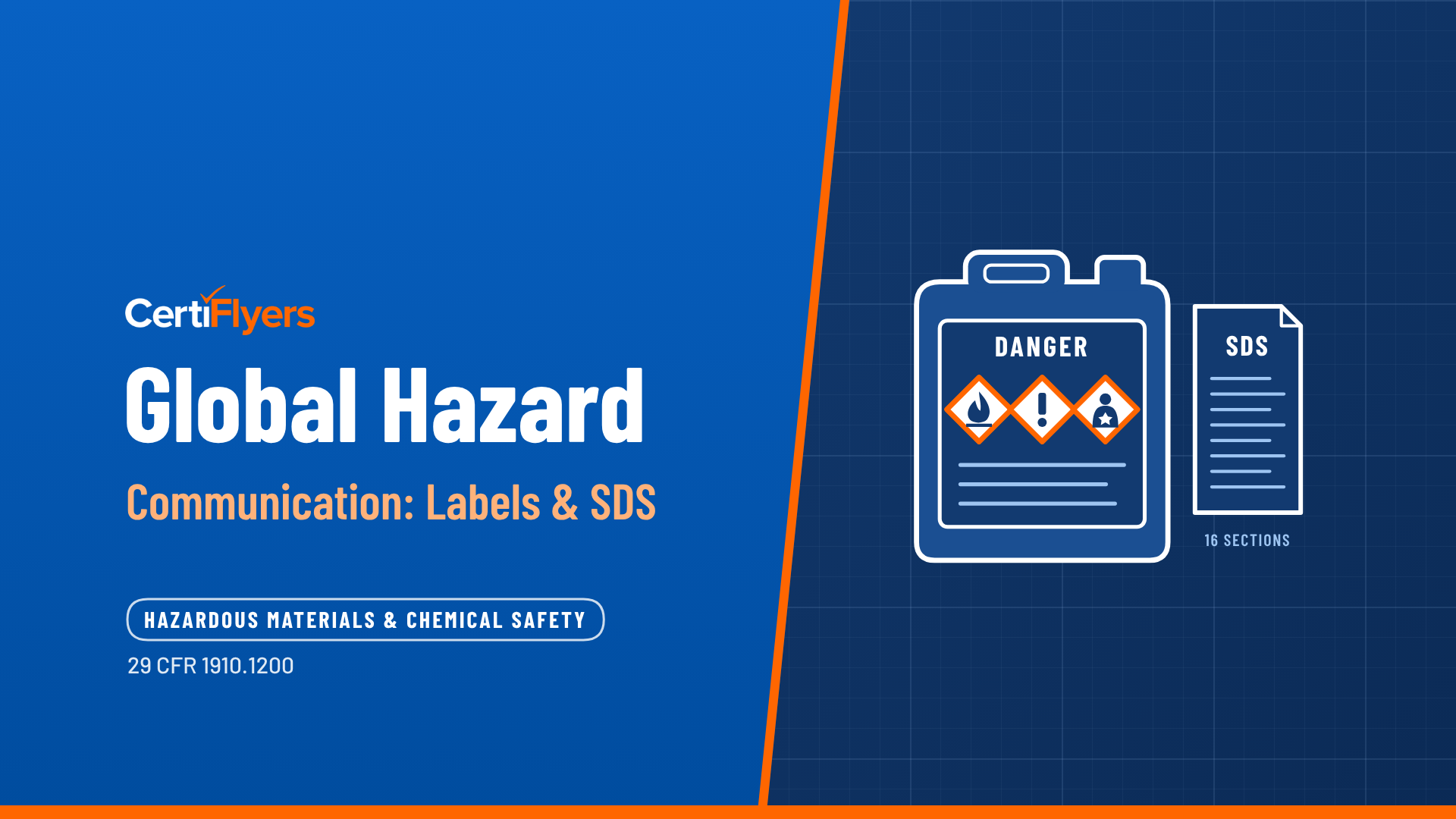 Hazardous Materials & Chemical Safety Global Hazard Communication Tap for details Hazardous Materials & Chemical Safety Global Hazard Communication Label read, Safety Data Sheet checked, then the container opens.
-
 Human Factors & Professional Skills Human Factors Primer Tap for details Human Factors & Professional Skills Human Factors Primer Awareness before action: run a PEAR check before every safety-critical task.
-
 Maintenance & Repair Practices Integral Fuel Tank Maintenance and Leak Detection Tap for details Maintenance & Repair Practices Integral Fuel Tank Maintenance and Leak Detection Prove the air before entry; repair the leak at its source.
-
 Shop & Hangar Safety Personal Protective Equipment Tap for details Shop & Hangar Safety Personal Protective Equipment Assess the hazard, inspect the gear, confirm the fit, then start.
-
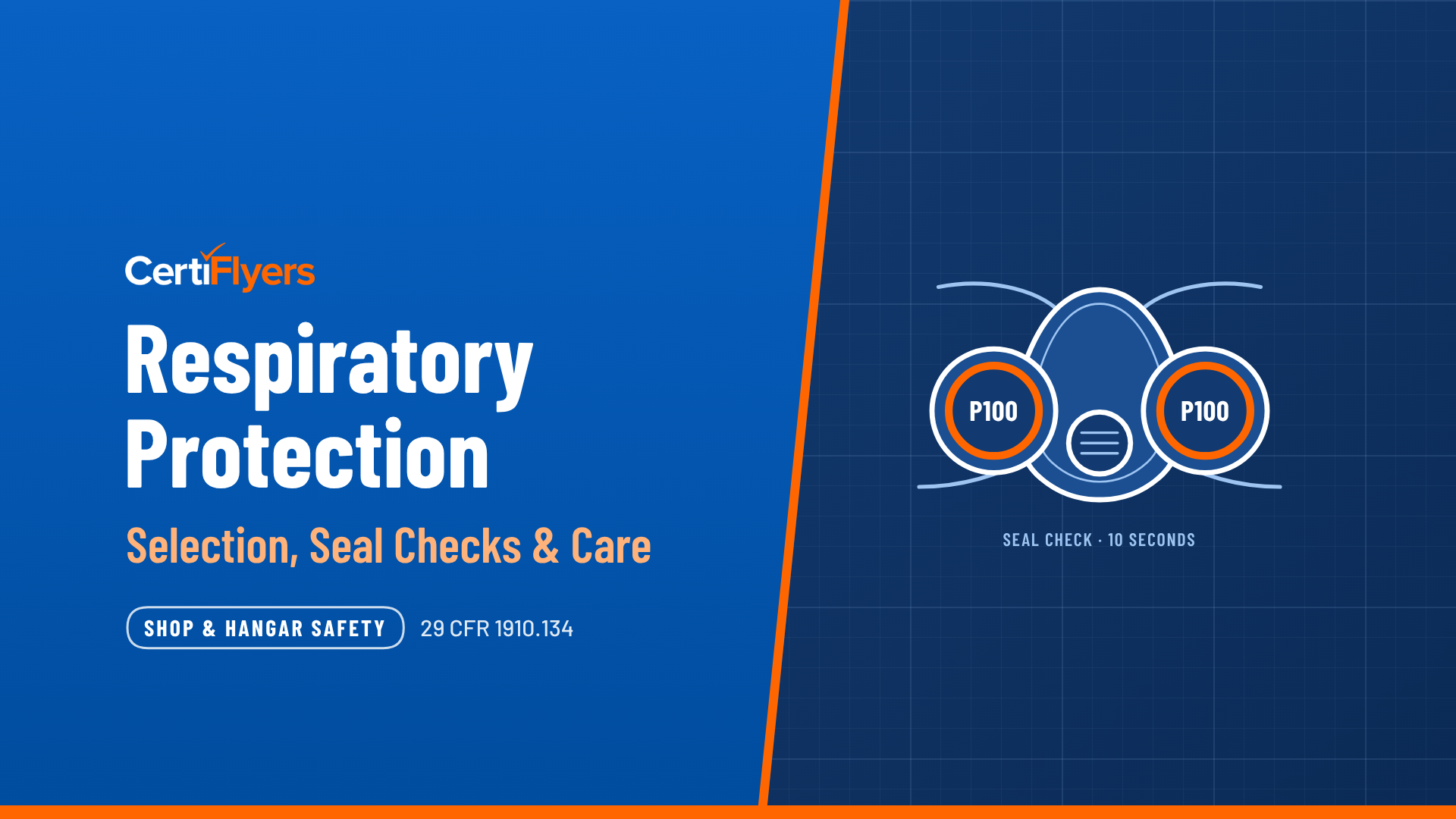 Shop & Hangar Safety Respiratory Protection Tap for details Shop & Hangar Safety Respiratory Protection Select for the atmosphere, seal-check every donning, never trust your nose.
Pricing
One price per person. It drops as your team grows.
Every account can take one course free. No card needed.
Buy only the courses each person needs.
Courses per person
1
Your estimate · Technician plan
1 person 1 course $12.99 $12.99
Pay by card and invite your team today. Want to try first? Start a free 14-day trial.
Every course for a year, on your own account. Buying for a team? Add people above.
Prices per person, in US dollars. Team plans include the manager tools and the team training record. More than 100 people? Talk to us.
Free resources
Start without paying anything
Task cardFree course
Take one course free, start to finish
- STEP 1Create a free account
- STEP 2Take the free course: video, slides and quiz
- STEP 3Pass and download your certificate
WARNINGNOTE
Hangar Cards
One-page checklists to keep at the workstand: the steps, the limits and the warnings.
4 are free to print. The others unlock when you pass the course.
Browse the cards →14 CFR · AC · 29 CFR · EASA
Regulations library
Links to the eCFR, FAA advisory circulars and forms, EASA and OSHA, sorted by topic.
Open the library →Is CertiFlyers training FAA-approved?
CertiFlyers is an independent training provider, not an FAA-approved program. Each course is built on the regulation or standard it teaches, and your quality team decides how it fits your own training program.
What does a course include?
A narrated video, a slide deck, a quiz, and a certificate when you pass.
How do I track my team?
You assign courses and see who has completed, started or not started each one. Every certificate carries a QR code that anyone can scan to check it is valid.
Can your team train on their phones?
Yes. CertiFlyers courses run on the web and in the iPhone and Android apps, so your team can train between jobs or at home. A company's own courses, documents to sign and classroom sign-ins open on the web, in any browser, phones included.
Can our QA reviewer look at the courses before we buy?
Yes. We give your manager or QA reviewer free access to the courses you choose, for as long as the review takes. It is marked as evaluation, so it never counts as completed training. Ask for evaluation access.
Where is our training data kept?
In your CertiFlyers account, on Google Cloud servers in the United States. The privacy policy explains what we keep, for how long, and how to delete an account.
Contact us
Questions? Write to us
A person reads every message and answers, typically in under 24 hours. It can take longer while we’re dealing with an issue.
Or write to support@certiflyers.com. Want a walkthrough for your team? Book a demo ›
Message sent.
We’ll answer at , typically in under 24 hours.