Shop & Hangar Safety
Eye and Face Protection
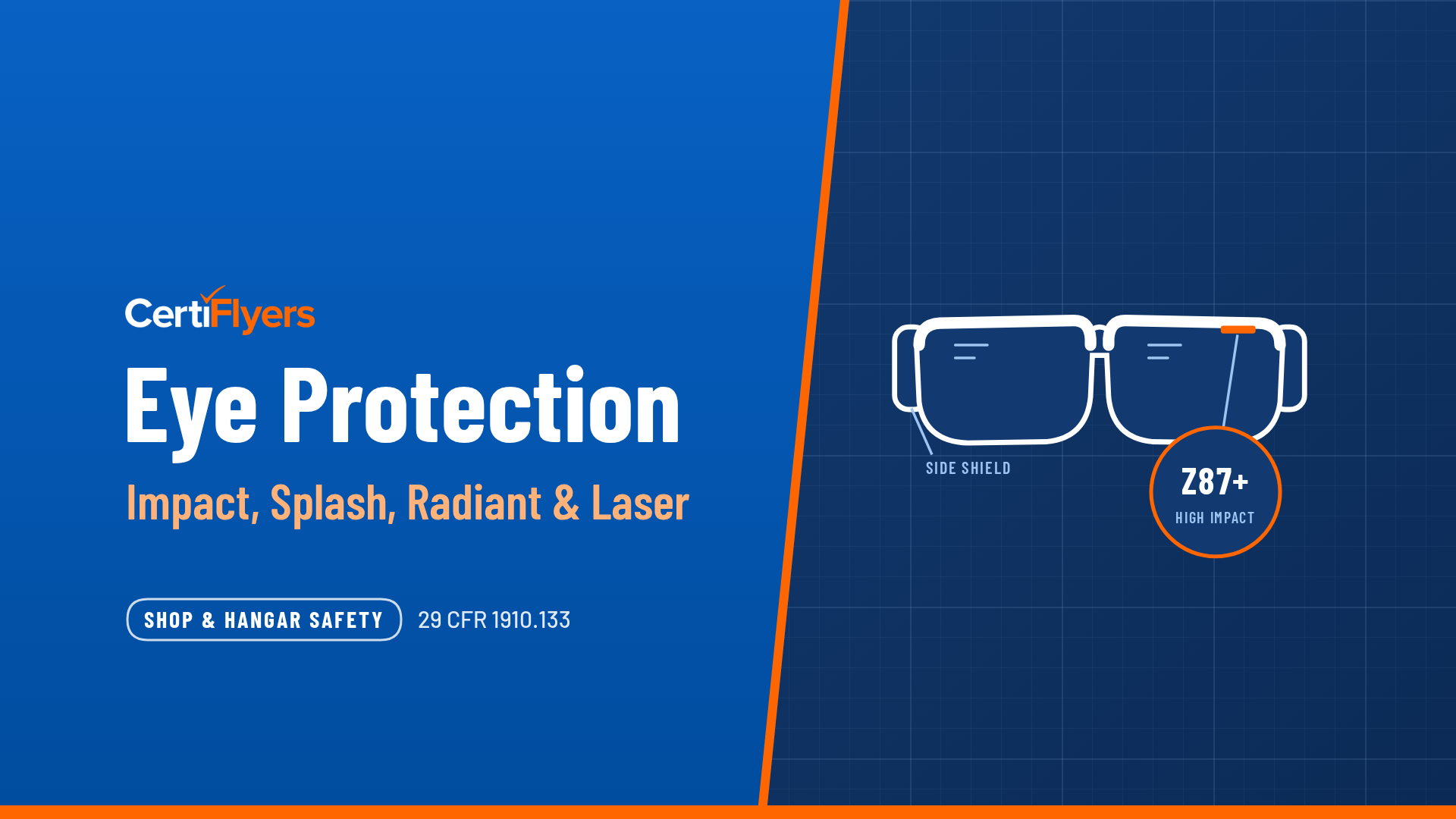
Match the eyewear to the hazard: no Z87 mark, no use.
THE 3 MODULESOne at a time, video and slides
- Hazards and eyewear selection Hazard Identification and PPE Selection.
- Inspection and care Inspection and Maintenance of Protective Eyewear.
- Emergency response Emergency Procedures for Eye Injuries.
YOU'LL BE ABLE TO4 things, on the job
- Assess tasks for hazards.
- Select marked eye protection.
- Inspect and replace eyewear.
- Respond to eye injuries.
TEST YOURSELFA question from module 2
While a technician drills out a rivet, a metal chip strikes the lens of the technician's safety glasses. A careful look shows no crack or scratch. What should happen to the glasses?
A Remove them from service and get a replacement pair from the supervisor.
Right. the course removes eyewear from service after any impact, even with no visible damage, because it may no longer meet its original ANSI impact rating, and 29 CFR 1910.132(e) bars defective or damaged personal protective equipment.
B Keep using them, since there is no visible damage.
Not quite. eyewear that has sustained an impact is replaced even when no damage is visible, because its structural integrity may be compromised.
C Clean them with an industrial solvent to reveal any hidden cracks.
Not quite. harsh workshop chemicals such as industrial solvents degrade the materials and ruin anti-fog coatings, so eyewear is cleaned only with mild soap and warm water.
D Inspect them under a bright light and keep them if the lenses pass.
Not quite. a visual inspection cannot clear eyewear after an impact; the course replaces it whether or not damage shows.
Stuck? In the course, Crew Chief, your AI tutor, explains it.
HANGAR CARDUnlocks when you pass
If you can't read Z87 on it, it isn't eye protection.
| Number | What it means |
|---|---|
| Z87+ | high-impact rating for grinding, chipping and machining |
| 10 s | maximum travel to an eyewash station — about 55 feet |
| 15–20 min | continuous flushing after a chemical splash — even if it feels better |
| 60–100 °F | tepid eyewash water, 16–38 °C, for a 15-minute flush |
| D3 · D4 · D5 | splash · dust · fine-dust markings on the eyewear |
| 10–15 s | the most critical window after a corrosive splash: get to the eyewash |
Unlocks when you pass this course
BUILT ONThe standards behind it
- 29 CFR 1910.133eye and face protection: when it must be used, compliance with ANSI Z87.1 or equivalent effectiveness, the manufacturer's marking, and side protection where flying objects are a hazard.
- ANSI/ISEA Z87.1the consensus standard for occupational eye and face protectors: the Z87 and Z87+ impact ratings and the D3, D4, D5, W, U, L and R marking codes.
- 29 CFR 1910.132(e)defective or damaged personal protective equipment (PPE) shall not be used: the basis for removing damaged eyewear from service.
- 29 CFR 1910.151(c)suitable facilities for quick drenching or flushing of the eyes where corrosive materials are used.
- ANSI/ISEA Z358.1the consensus standard for emergency eyewash equipment, which the course uses for reach within 10 seconds, tepid water and a 15-minute flow.
QUESTIONSWhat technicians ask first
- Who is this course for?
- Maintenance technicians and mechanics of all type ratings, and other shop floor personnel. The only prerequisite is a basic workshop safety orientation.
- What do the Z87, Z87+ and D3, D4, D5 markings mean?
- Z87 is the basic impact rating, tested by drop ball only, and Z87+ is the high impact rating, tested by the high-mass and high-velocity impact tests. D3 marks protection against droplets and splash from liquid chemicals, D4 against dust and D5 against fine dust. The eyewear must also carry the manufacturer's mark, and eyewear with no Z87.1 marking must not be used as PPE, whatever the box claims.
- I wear prescription glasses. What are my options?
- Use safety eyewear that incorporates your prescription into its design. The other option is approved safety goggles or glasses that fit completely over your personal glasses without disturbing their proper position.
- When do I need a face shield?
- For severe splash or flying objects, wear a face shield in combination with safety glasses or goggles. A face shield on its own does not give adequate protection against impact hazards.
- What do I do after a chemical splash in the eye?
- Go to the nearest eyewash station at once, because the first 10 to 15 seconds are the most critical window for preventing permanent tissue damage. Hold your eyelids open, flush continuously with clean water for at least 15 to 20 minutes, never rub your eyes, and seek medical help after flushing. Do not stop early, even if the eye feels better, because residual chemical can keep damaging tissue.
- Where should eyewash stations be, and what should they deliver?
- 29 CFR 1910.151(c) requires suitable facilities for quick drenching or flushing of the eyes where corrosive materials are used. The course applies ANSI/ISEA Z358.1, the consensus standard for this equipment: a station within 10 seconds (about 55 feet) of the hazard, tepid water at 60 to 100 °F (16 to 38 °C) and a continuous flow of at least 15 minutes. Know where your station is and how it works before a hazardous task, and keep its marked area and access path clear, because a splash victim may be partly or fully blinded.