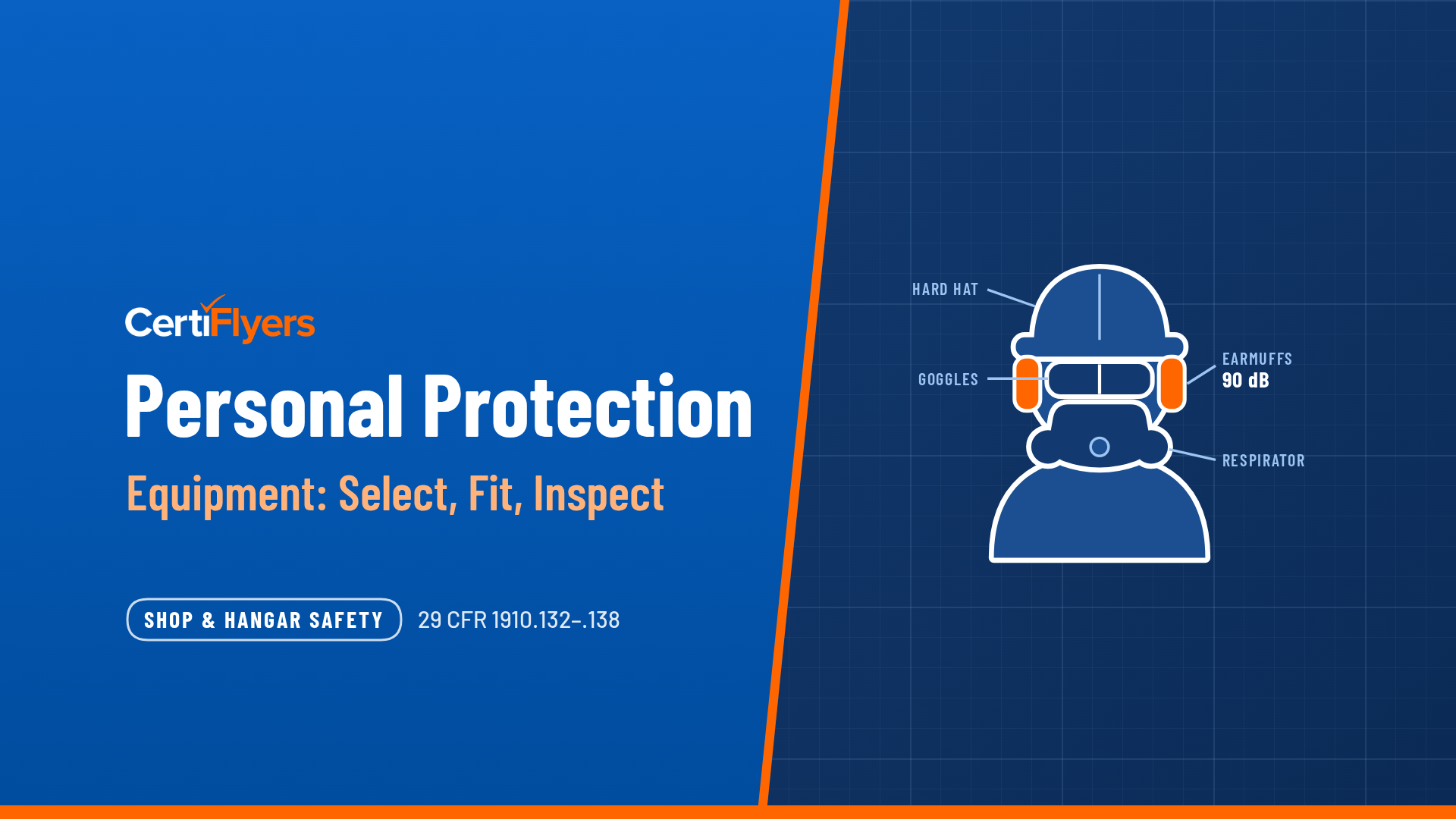
Shop & Hangar Safety
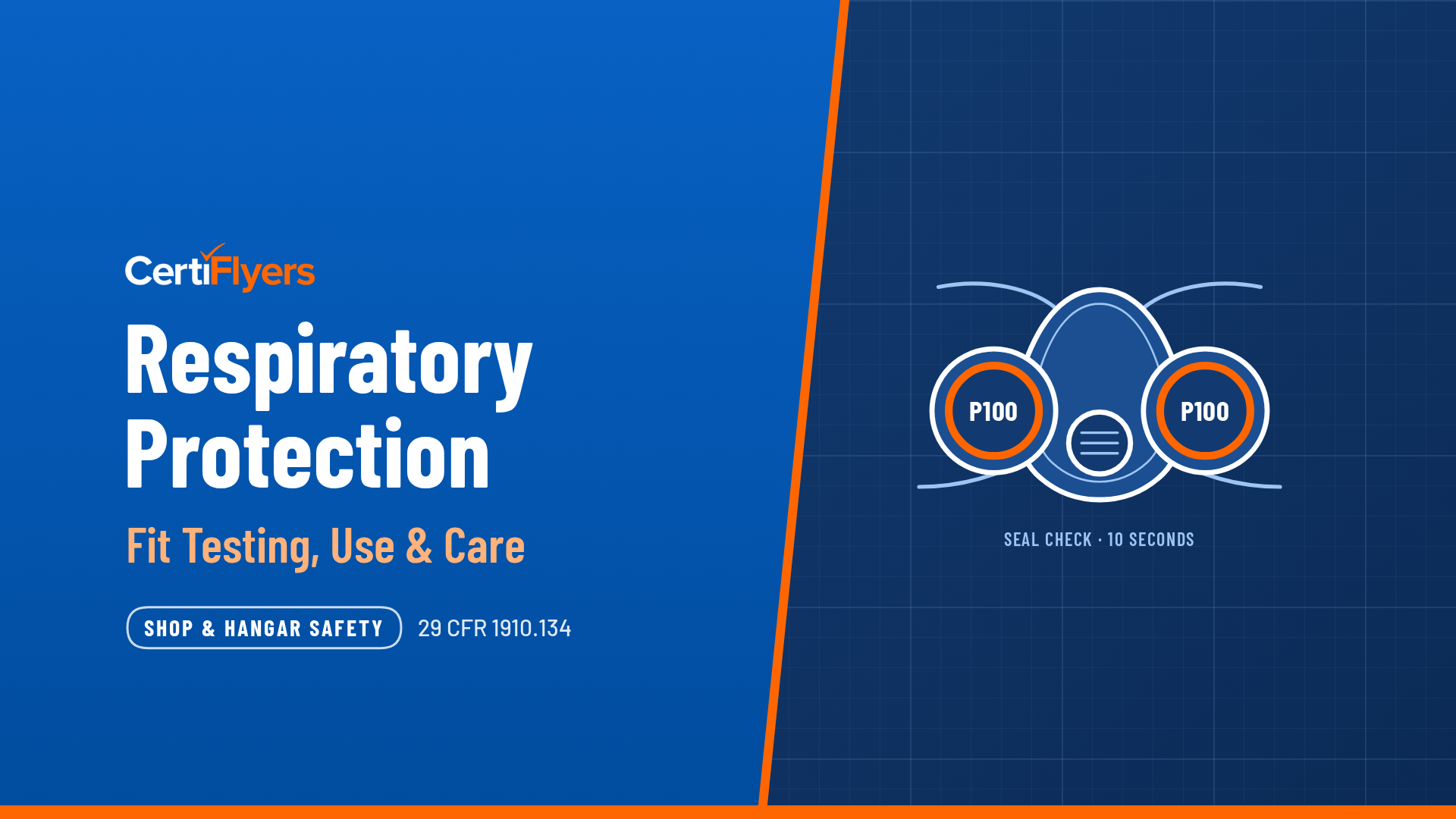
Respiratory Protection
Select for the atmosphere, seal-check every donning, never trust your nose.
THE 5 MODULESOne at a time, video and slides
- Hazards and your health Respiratory Hazards and Your Health.
- Choosing the right respirator Respirator Types and Selection Criteria.
- Inspection and seal checks Pre-Use Inspection and User Seal Checks.
- Cleaning, disinfection and storage Respirator Cleaning, Disinfection, and Storage.
- Cartridge life and breakthrough Operational Use and Filter/Cartridge Replacement.
YOU'LL BE ABLE TO4 things, on the job
- Identify physiological risks.
- Select the respirator type.
- Inspect and seal-check.
- Clean, store, manage cartridges.
TEST YOURSELFA question from module 3
Before mixing a two-part polyurethane primer, a technician dons a half-mask respirator. During the negative pressure check, the facepiece does not stay collapsed while the breath is held. What comes next?
A Do the positive pressure check instead, since one passing check is enough.
Not quite. the course requires both a positive and a negative pressure user seal check every time the respirator is donned.
B Start mixing, since the annual fit test already confirmed the fit.
Not quite. 29 CFR 1910.134(g)(1)(iii) requires a user seal check every time a tight-fitting respirator is put on, and the fit test does not replace it.
C Pull the straps tighter and start mixing without repeating the check.
Not quite. a facepiece that does not stay collapsed signals an inward leak, and the seal check has to pass before the respirator is used.
D Remove the mask, inspect the facepiece and valves, and tag it out of service if a part is torn.
Right. under 29 CFR 1910.134(h)(3) a respirator is inspected before each use, and a defective one, such as one with a torn inhalation valve, is tagged out of service and repaired before the task.
Stuck? In the course, Crew Chief, your AI tutor, explains it.
HANGAR CARDUnlocks when you pass
Below 19.5% oxygen it's IDLH — no air-purifying respirator of any kind.
| Number | What it means |
|---|---|
| 19.5–23.5% | oxygen monitoring must prove — with contaminant levels known — before a fuel tank is no longer treated as IDLH |
| 10 seconds | hold the negative pressure check; the facepiece must stay collapsed |
| P100 | pink particulate filter for composite dust; organic vapor cartridge for solvents |
| 43 °C | maximum wash water (110 °F), mild detergent, no organic solvents |
| 50 ppm | hypochlorite: immerse components two minutes, then rinse thoroughly |
| 17.1% | fuel tank oxygen reading: the technician refused a half-mask and used full-facepiece pressure-demand air (SCBA, or SAR with auxiliary escape bottle) |
Unlocks when you pass this course
BUILT ONThe standards behind it
- 29 CFR 1910.134(a), (b) and (d)Permissible practice, definitions (IDLH, oxygen-deficient atmosphere, employee exposure) and respirator selection, including IDLH atmospheres under (d)(2) and the assigned protection factors of Table 1.
- 29 CFR 1910.134(d)(3)(iii)Protection against gases and vapors: a cartridge with a NIOSH-certified ESLI, or a written change schedule.
- 29 CFR 1910.134(g) and Appendix B-1Facepiece seal protection, including a user seal check every time a tight-fitting respirator is put on, and the seal check procedures.
- 29 CFR 1910.134(h) and Appendix B-2Cleaning, disinfection, inspection and storage of respirators, and the mandatory cleaning procedure.
- NIOSH Pocket Guide to Chemical HazardsIDLH values for chemicals.
QUESTIONSWhat technicians ask first
- Who is this course for?
- Aircraft maintenance technicians and mechanics, especially structures, paint and fuel tank specialists. Before starting, you need medical clearance to wear a respirator, baseline hazardous materials awareness and initial fit testing.
- Can I wear an air-purifying respirator in a fuel tank?
- Not until monitoring proves oxygen between 19.5% and 23.5% and that contaminant concentrations are known, because the course treats any confined space as IDLH until then. Below 19.5% oxygen, or with unknown concentrations, no air-purifying respirator of any kind is permitted. The choice is then a full-facepiece pressure-demand SCBA, or a full-facepiece pressure-demand SAR with an auxiliary escape bottle.
- Which filter or cartridge do I need?
- Match it to the physical form of the hazard: a NIOSH-certified high-efficiency particulate air (HEPA) or P100 filter for dust such as sanded fiberglass or composite, and the correct organic vapor cartridge for solvent vapors such as MEK. Filters and cartridges are color-coded, for example pink for P100. The respirator's APF must also be high enough to bring your exposure below the PEL.
- Can I wear a tight-fitting respirator with a beard or stubble?
- No, not if facial hair crosses the sealing surface: it compromises the seal, and tightening the straps cannot restore it. The same applies to corrective glasses, goggles or face shields worn in a way that interferes with the face-to-facepiece seal.
- How do I clean and disinfect my respirator?
- Remove the filters or cartridges, disassemble speaking diaphragms and valve assemblies as the manufacturer recommends, and wash the parts with a mild detergent in warm water no hotter than 43 °C (110 °F), never in organic solvents. Rinse, disinfect by immersing for two minutes in a 50 parts per million (ppm) hypochlorite (bleach) solution, an iodine solution or an approved commercial cleanser, then rinse thoroughly in clean, warm running water. Air-dry or hand-dry with a lint-free cloth, reassemble, and store the respirator so the facepiece and exhalation valve are not deformed, away from dust, sunlight, extreme temperatures and damaging chemicals.
- When do I change cartridges?
- On the ESLI if the cartridge has one, or else at the time limit in your shop's change schedule, as 29 CFR 1910.134(d)(3)(iii) requires one or the other for gases and vapors. Never wait to smell the chemical, because olfactory fatigue dulls your sense of smell while the exposure continues. If you smell or taste the chemical, find breathing harder or feel leakage at the seal, exit to clean air immediately.