Shop & Hangar Safety
Aircraft Confined Space & Fuel Tank Entry Procedures
No posted permit, no Attendant outside: don't break the plane.
THE 3 MODULESOne at a time, video and slides
- Classifying the space Identification and Hazards of Aircraft Confined Spaces.
- Isolate, ventilate, test Pre-Entry Preparation and Atmospheric Testing.
- Working inside the tank In-Tank Maintenance Practices and Emergency Execution.
YOU'LL BE ABLE TO4 things, on the job
- Identify confined space hazards.
- Establish safe entry conditions.
- Perform in-tank maintenance safely.
- Keep the buddy system.
TEST YOURSELFA question from module 3
An entrant working inside a fuel tank stops answering the Attendant's radio calls and tapping signals. The Attendant is alone at the opening and has not been trained or equipped for rescue. What does the Attendant do?
A Climb in at once to pull the entrant out.
Not quite. The Attendant may enter only when relieved by another attendant and trained and equipped for rescue, and this Attendant is neither.
B Ask a nearby co-worker to go in while the Attendant watches.
Not quite. Rescue is for trained rescue personnel, and National Institute for Occupational Safety and Health (NIOSH) data show more than 60% of confined space fatalities are would-be rescuers rather than the original entrant.
C Keep calling for a few more minutes before raising the alarm.
Not quite. The Attendant's role when an entrant goes down is to summon trained rescue personnel immediately.
D Stay outside and summon trained rescue personnel immediately.
Right. OSHA 29 CFR 1910.146 prohibits the Attendant from entering unless relieved by another attendant and trained and equipped for rescue, so the Attendant summons trained rescue at once.
Stuck? In the course, Crew Chief, your AI tutor, explains it.
HANGAR CARDUnlocks when you pass
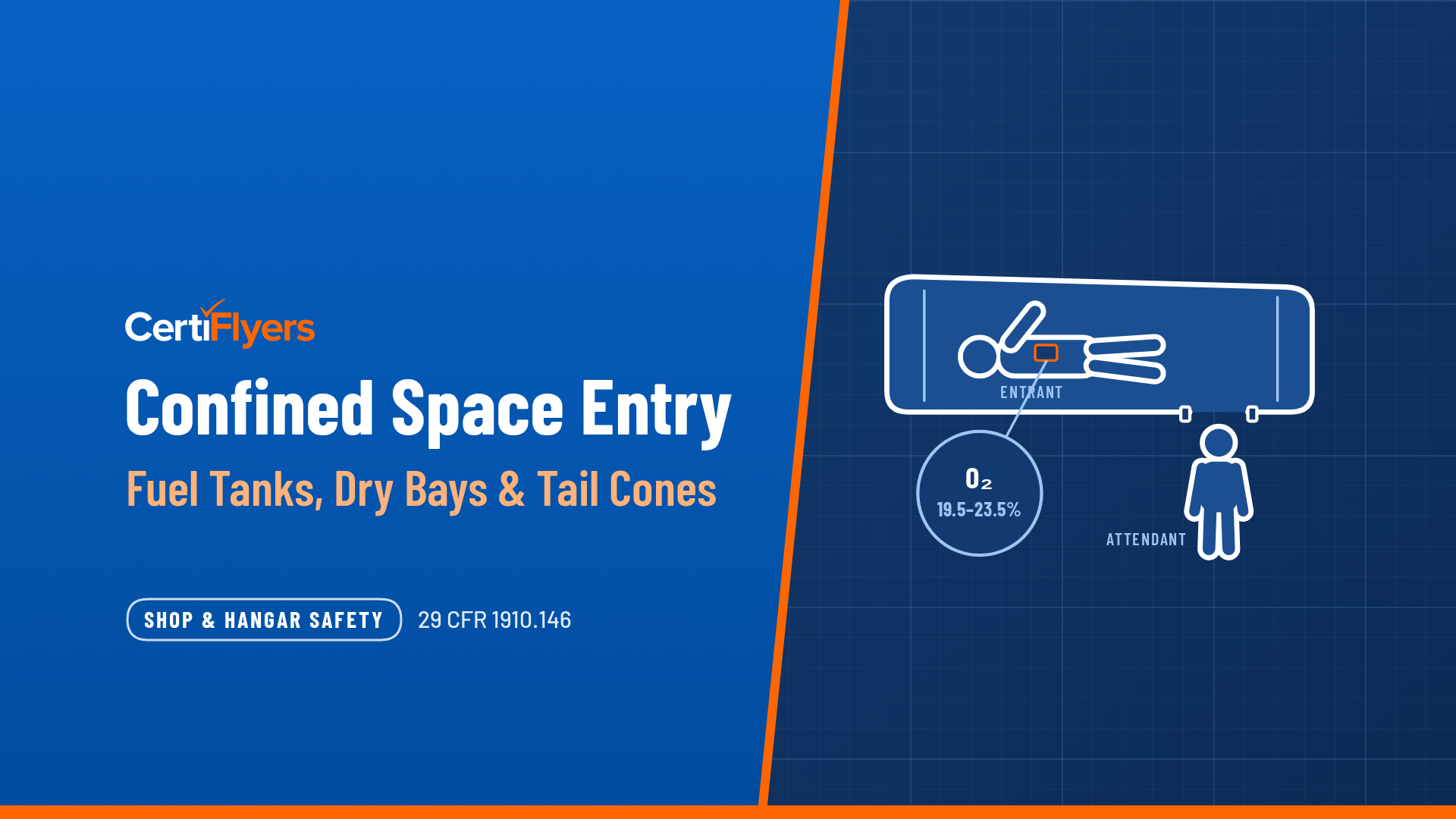
The Attendant stays outside — even when the entrant goes down.
| Number | What it means |
|---|---|
| 19.5–23.5% | acceptable oxygen, tested first |
| < 10% LEL | flammable gas, tested second |
| < 25 ppm | carbon monoxide, tested third; some programs use NIOSH's 35 ppm exposure limit |
| 15 min | ventilation off before atmospheric testing, so the monitor reads raw air |
| 1 ohm | maximum DC resistance for a bonding jumper on in-tank metal |
| > 60% | of confined space deaths are would-be rescuers, not the entrant (NIOSH) |
Unlocks when you pass this course
BUILT ONThe standards behind it
- OSHA 29 CFR 1910.146, Permit-required confined spacesThe primary federal standard for the course: space classification, entry permits, acceptable entry conditions, Attendant duties and rescue and emergency services.
- ANSI/ASSP Z117.1-2022, Safety Requirements for Entering Confined SpacesThe industry consensus standard the course draws on for additional guidance on confined space hazard control and safe work practices.
- OSHA 29 CFR 1910.147, Control of hazardous energyLockout/tagout, used in Module 2 to disable all aircraft power sources and eliminate ignition sources before entry.
- OSHA 29 CFR 1910.134, Respiratory protectionCited with 1910.146(d)(4), equipment for permit space entry, for the respirators and other protective equipment worn inside the tank.
- NFPA 70 (NEC) Article 500Defines Class I, Division 1 hazardous (classified) locations, the certification the course requires for lighting and tools used inside the fuel tank.
- NTSB/AAR-00/03, TWA Flight 800 (1996)The center wing fuel tank explosion investigation, used in Module 1 to show how little ignition energy fuel/air vapors in an enclosed tank need.
QUESTIONSWhat technicians ask first
- Who is this course for?
- Aircraft maintenance technicians and mechanics, whether Airframe and Powerplant (A&P) mechanics or aircraft maintenance engineers (AMEs), who work in aircraft confined spaces such as fuel tanks. It assumes medical clearance, respirator fit-testing and basic aircraft maintenance knowledge.
- Is an aircraft fuel tank a permit-required confined space?
- Following the employer's evaluation under 29 CFR 1910.146(c)(1), an aircraft fuel cell is treated as a permit-required confined space (PRCS) after its initial use, because residual jet fuel vapors are toxic and combustible. A PRCS needs a written entry permit, an Entry Supervisor, attendants and trained rescuers before entry.
- What readings allow entry, and in what order are they taken?
- Oxygen between 19.5% and 23.5%, flammable gas below 10% of the LEL, carbon monoxide below 25 ppm (some programs use 35 ppm, the NIOSH recommended exposure limit) and hydrogen sulfide below 10 ppm. Test oxygen first, then combustible gases, then toxic gases, using a freshly bump-tested and calibrated multi-gas monitor with an extension probe at various depths.
- Can ventilation stop once the readings are good?
- No. Continuous forced-air ventilation from a clean air source is maintained for the entire duration of the entry. In 1996 a United Airlines mechanic died of asphyxia inside a Boeing 767 wing fuel tank at Dulles while removing old sealant with MEK; the tank had no adequate fresh-air ventilation, and an organic-vapor cartridge respirator could not protect the mechanic.
- What tools and equipment can go into a fuel tank?
- Only non-sparking tools and explosion-proof lighting, certified for Class I, Division 1 hazardous locations. Power tools must be air-driven (pneumatic), and electric-powered tools are strictly prohibited inside the tank. In-tank metal is bonded to the aircraft structure with a flexible braided jumper wire at a DC resistance of 1 ohm or less.
- What does the Attendant do if the entrant goes down?
- Stay outside and summon trained rescue personnel immediately. OSHA 29 CFR 1910.146 prohibits the Attendant from entering unless relieved by another attendant and trained and equipped for rescue. According to NIOSH, more than 60% of confined space fatalities are would-be rescuers, not the original entrant.