Maintenance & Repair Practices
Integral Fuel Tank Maintenance and Leak Detection
Prove the air before entry; repair the leak at its source.
THE 4 MODULESOne at a time, video and slides
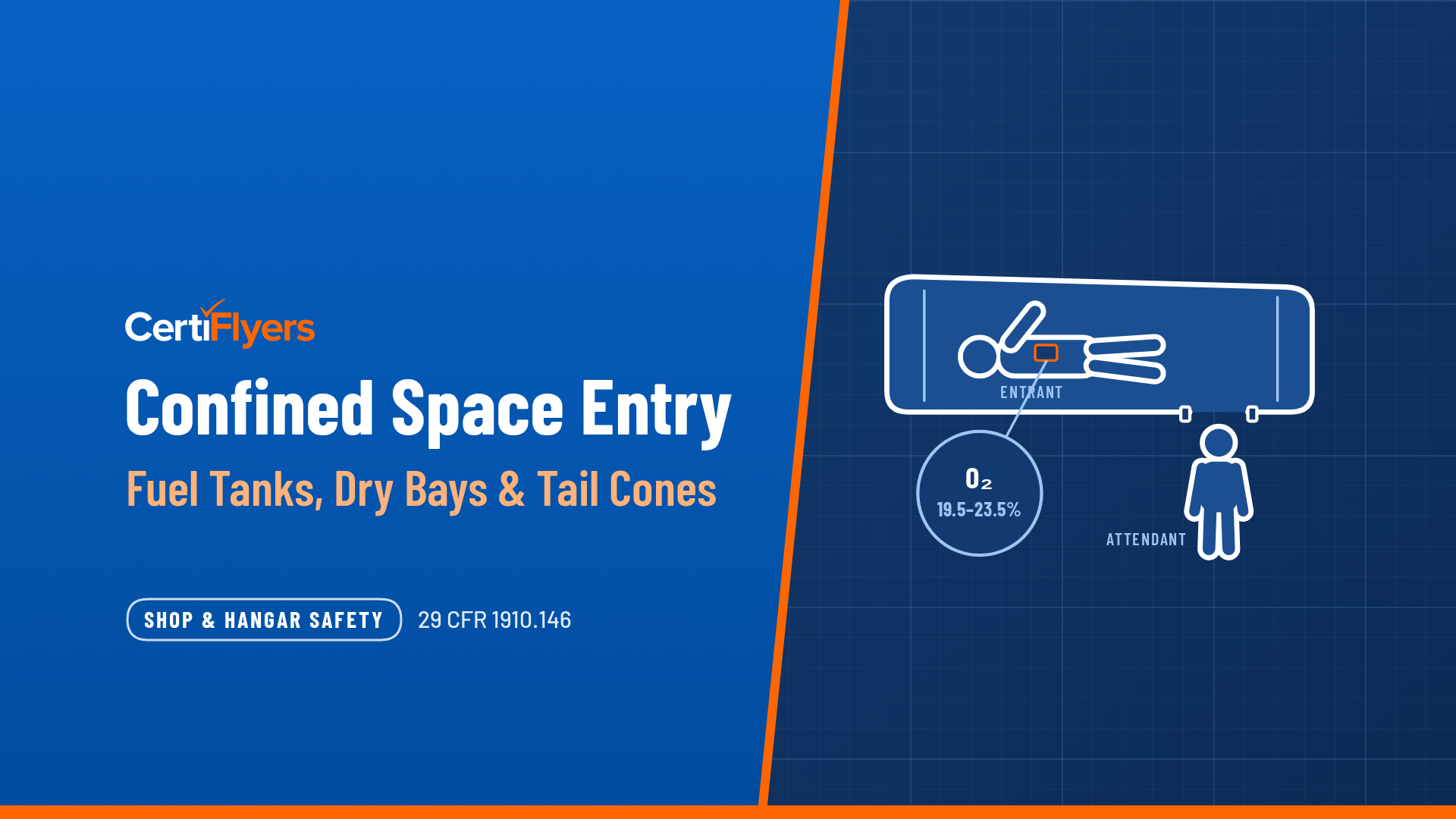
- Safe tank entry Fuel Tank Safety and Confined Space Entry.
- Sealants and surface preparation Sealant Fundamentals.
- Leak classification and testing Fuel Leak Evaluation and Testing Methodologies.
- Wet-install fastener repair Wet Fastener Repair.
YOU'LL BE ABLE TO4 things, on the job
- Prepare a safe entry.
- Prepare and apply sealants.
- Classify and test leaks.
- Repair wet-installed fasteners.
TEST YOURSELFA question from module 3
A heavy seep on a lower wing surface was covered with an external patch. After the next flight, fuel appears two feet away along a stringer. What is the permanent fix?
A Trace the internal source, for example with the blow back method, and repair it from inside.
Right. external exit points rarely coincide with the internal source, and permanent repairs must address the internal source.
B Patch the new exit point as well.
Not quite. fuel channels to the next least restrictive exit point, so external cosmetic repairs often fail.
C Raise the positive test pressure above the manual's value to find the leak faster.
Not quite. the test pressure is the one specified in the aircraft technical manual, and it must never be exceeded.
D Leave it, since the patch already returned the aircraft to service.
Not quite. a temporary external repair can sometimes return the aircraft to service, but a permanent internal repair is required when the tank is next opened.
Stuck? In the course, Crew Chief, your AI tutor, explains it.
HANGAR CARDUnlocks when you pass
Final torque within the sealant's application life — or start over.
| Number | What it means |
|---|---|
| 600 PPM | maximum VOC for standard entry — 10% LEL |
| > 1200 PPM | IDLH — above this, or oxygen outside 19.5–23.5%, nobody enters |
| 30 min | minimum purge before entry; also adhesion promoter drying time |
| 6 min | after wiping dry — read the wetted area to classify the leak |
| TO 1-1-3 | the USAF technical order for tank entry limits, sealing and leak classes |
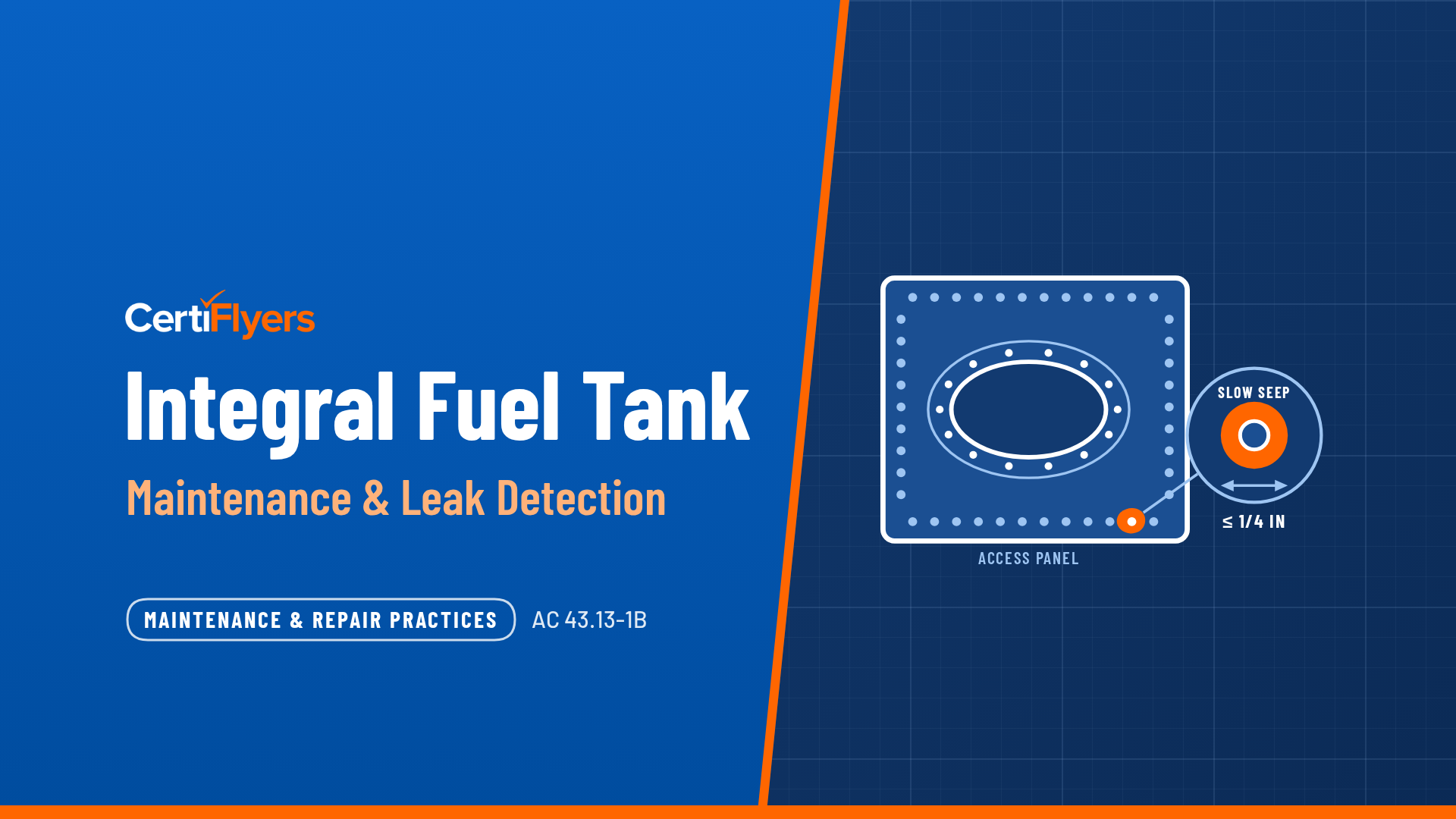
| ≤ 1/4 in | slow seep wetted area; 3/4 to 8 inches (depending on fuel type) is a heavy seep |
Unlocks when you pass this course
BUILT ONThe standards behind it
- TO 1-1-3Inspection and repair of aircraft integral tanks and fuel cells: entry procedures, atmospheric thresholds, purging, roles, sealing materials, leak classification and wet installation of fasteners.
- 14 CFR § 25.981Fuel tank ignition prevention: no ignition source may be present at any point where catastrophic failure could occur.
- Special Federal Aviation Regulation (SFAR) No. 88Fuel tank system fault tolerance evaluation: design approval holders reviewed fuel tank systems and developed the instructions from which Critical Design Configuration Control Limitation (CDCCL) requirements derive.
- EASA Part-MThe European Union Aviation Safety Agency (EASA) framework for continued airworthiness maintenance procedures.
- AMMs, SRMs and weapons system Technical OrdersThe procedures, approved materials, torque values, sealant application life limits and pressure test parameters for each fuel tank repair on a given aircraft type.
QUESTIONSWhat technicians ask first
- Who is this course for?
- Maintenance technicians and mechanics with aviation maintenance experience who work on integral fuel tanks. It assumes familiarity with aircraft technical documentation such as the AMM and SRM, a basic understanding of aircraft fuel systems, and the required confined space entry qualifications.
- When is a fuel tank safe to enter?
- When a multi-gas meter with a photo ionization detector (PID), oxygen and combustible-gas sensors shows oxygen between 19.5% and 23.5% and VOC at or below 600 PPM (10% LEL), after at least 30 minutes of purging. Between 600 and 1200 PPM, extended purging is required before entry. Above 1200 PPM (20% LEL), or with oxygen outside 19.5–23.5%, the atmosphere is IDLH: nobody enters, and you stop work and notify your supervisor.
- How do I classify a fuel leak?
- Wipe the area dry, apply a detection method such as red talcum powder, and evaluate the wetted area exactly 6 minutes later. A slow seep is up to 1/4 inch, a seep 1/4 to 3/4 inch and a heavy seep 3/4 to 8 inches (depending on fuel type), while a running leak immediately grounds the aircraft. For every class, the required action also depends on where the leak is: external, internal vented or non-vented, in an electrical conduit or externally mounted component, or near sources of heat.
- What pressure do I use for a positive pressure leak test?
- The test pressure specified in the aircraft technical manual (for example, 2.0 to 2.5 pounds per square inch where specified), and never more. Before pressurizing, remove the applicable caps listed in the manual, and keep the gauge monitor at the gauge, ready to disconnect the pressure source if the test is interrupted.
- What is a CDCCL, and why does it matter during a repair?
- A CDCCL is a feature of the fuel system design that must be retained during maintenance, repair or alteration so that unsafe conditions do not develop. CDCCL requirements for transport category aircraft derive from the maintenance and inspection instructions that SFAR No. 88 required design approval holders to develop after reviewing fuel tank systems against 14 CFR § 25.981, which bars any ignition source where catastrophic failure could occur. Following the maintenance manuals strictly is how a technician preserves them.
- When can the tank be refueled after a sealant repair?
- Only once the repair is verified completely tack-free, meaning the sealant's outer surface no longer sticks to a plastic film or application tool. Before that, the fillet must have been worked with a non-metallic spatula to force out trapped air and eliminate voids.