Shop & Hangar Safety
Fall Prevention
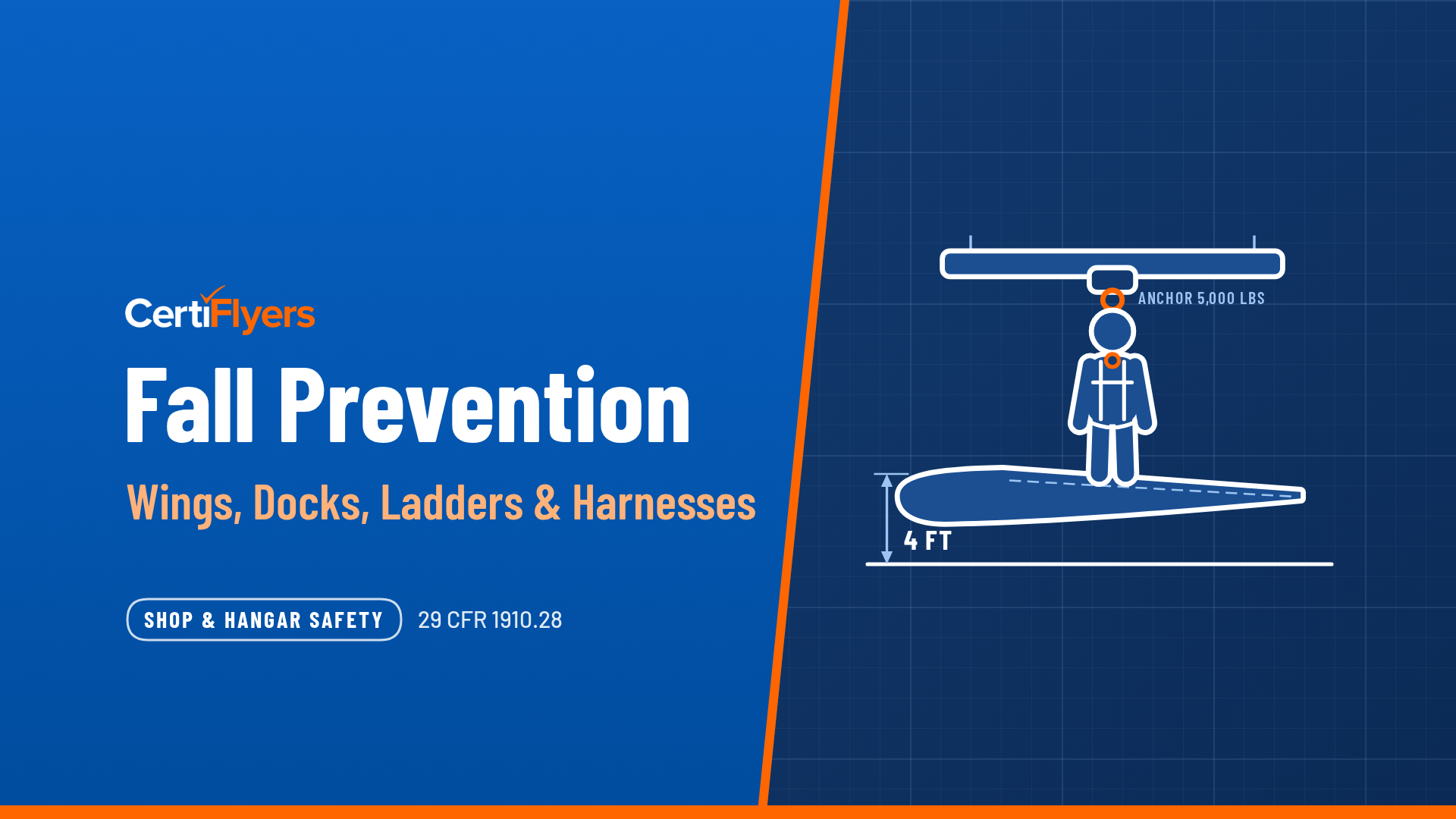
From four feet up, guardrails come first and the harness comes last.
THE 3 MODULESOne at a time, video and slides
- Thresholds and the hierarchy Fall Protection Thresholds and Hazard Control.
- Harness inspection and tie-off PFAS Selection, Inspection, and Use.
- Setting up access equipment Access Equipment — Ladders, Scaffolds, and Aerial Lifts.
YOU'LL BE ABLE TO4 things, on the job
- Identify fall protection thresholds.
- Inspect PFAS components.
- Apply correct tie-off.
- Configure access equipment.
TEST YOURSELFA question from module 1
A technician must reach a component on top of the fuselage. The work surface has an unprotected edge about 8 feet above the hangar floor, and the job will take only a few minutes. What comes first?
A Skip fall protection, since the task is short.
Not quite. Fall protection is generally required at or above 4 feet where unprotected edges exist, regardless of task duration.
B Try ground-based work first, and if that fails, use a stand with guardrails on all open sides.
Right. The hierarchy of controls puts elimination first and engineering controls such as guardrails before personal protective equipment (PPE), so ground-based work and a guarded platform come before a harness.
C Put on a harness and tie off to the nearest piece of structure.
Not quite. PPE is the last resort in the hierarchy of controls, and a PFAS connects to an approved anchorage point, not to whatever structure is nearest.
D Work from the fuselage carefully, staying well back from the edge.
Not quite. Technicians never work on unprotected elevated surfaces 4 feet or higher without mitigating the hazard, and they disengage and notify the supervisor if the task cannot be done safely.
Stuck? In the course, Crew Chief, your AI tutor, explains it.
HANGAR CARD · FREEThe pocket card that goes with it
4 feet and an open edge: guardrails first, PFAS last, or disengage.
| Number | What it means |
|---|---|
| 4 feet | or more, unprotected edge — fall protection is mandatory |
| 6 feet | maximum free fall — tie off at or above the dorsal D-ring |
| 5,000 lbs | anchorage strength per attached worker — or designed, installed and used under a qualified person's supervision, safety factor at least 2 |
| 70% | lanyard strength lost over a sharp edge without an abrasion-pad adapter |
| 1:4 | ladder base: 1 foot out for every 4 feet of vertical height |
| 36 inches | of side rail above the landing on a straight ladder |
Before you climb: check
PANEL STAYS OPEN
BUILT ONThe standards behind it
- OSHA 29 CFR 1910 Subpart D (general industry) and 29 CFR 1926 Subpart M (construction)The height thresholds in Module 1: 4 feet for general industry and 6 feet under the construction standards.
- OSHA 29 CFR 1910.140, Personal fall protection systemsThe personal fall protection systems rule cited for Module 2's PFAS selection, inspection and tie-off.
- ANSI/ASSP Z359 Fall Protection CodeThe US test standard for PFAS equipment; the course also cites modern ANSI standards for snaphook gates that withstand 3,600 lbs of force.
- EN 355 / EN 364 / EN 365European fall-protection standards: EN 355 energy absorbers, tested to EN 364, with EN 365 covering inspection and marking; arrest forces are limited to 6 kN or less.
- OSHA 29 CFR 1926 Subpart L (scaffolds) and Subpart X (ladders); 29 CFR 1910.23 and 1910.27The basis for Module 3's ladder, scaffold and aerial lift setup, including fully planked scaffolds and guardrails on platforms more than 10 feet above a lower level.
QUESTIONSWhat technicians ask first
- Who is this course for?
- Aircraft maintenance technicians (AMTs), aircraft maintenance engineers (AMEs) and mechanics who work on elevated aircraft surfaces, ramps and maintenance platforms. It assumes a basic maintenance safety orientation and familiarity with aircraft maintenance stands.
- At what height is fall protection required?
- In general industry, fall protection is required when a walking or working surface has an unprotected side or edge 4 feet or more above the next lower level, regardless of how long the task takes. OSHA's construction standards (29 CFR 1926) set the threshold at 6 feet.
- When does a technician use a harness instead of guardrails?
- Guardrails come first, because they are a passive system that stops a fall from happening, while a Personal Fall Arrest System only arrests a fall in progress. The course moves to a PFAS when platform guardrails must be removed or the technician is walking on the aircraft surface itself, connected to an approved overhead anchorage point.
- How strong must an anchorage be, and where should it be?
- Anchorages must support 5,000 lbs per attached worker, or be designed, installed and used under the supervision of a qualified person with a safety factor of at least 2. Tie off at or above the dorsal D-ring so free fall stays at 6 feet or less.
- Can a lanyard be wrapped around a beam or connected hook to hook?
- Do not tie off around H-beams, I-beams or sharp surfaces without an approved tie-off adapter with abrasion pads, because sharp edges can severely reduce lanyard strength. Never connect two snaphooks to each other, directly to a horizontal lifeline, back onto their own integral lanyard or directly to webbing.
- Is a harness needed in a scissor lift?
- Scissor lifts with a complete guardrail system do not require a harness and lanyard unless the guardrails are inadequate, the worker leaves the protected platform or the operator manual dictates it. Boom-type lifts are different: the technician ties off to the manufacturer-designated anchor point inside the basket at all times, never to the guardrail unless it is specifically rated for that purpose.