Safety Management & Quality
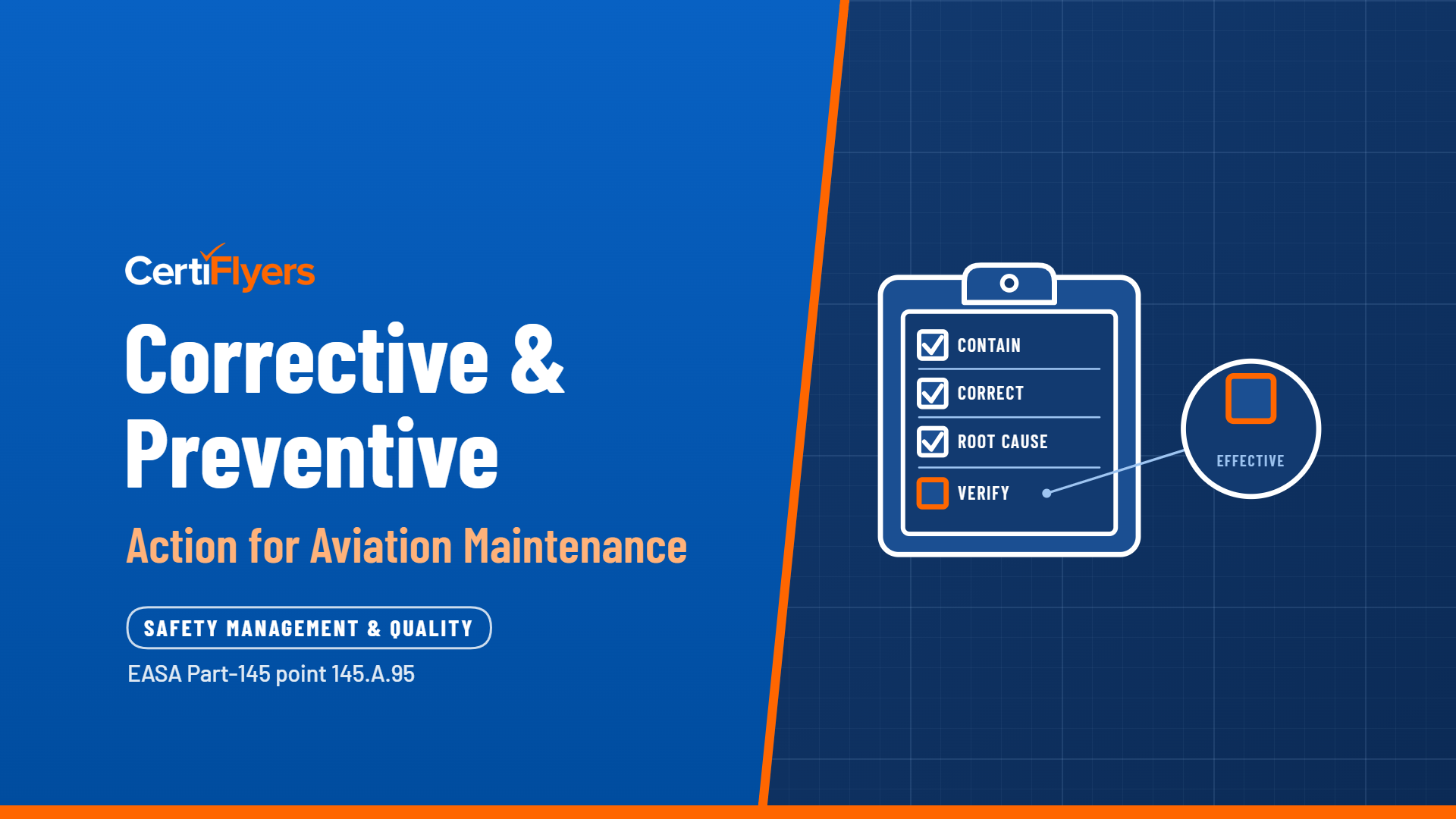
Corrective and Preventive Action
Contain first, remove the cause, and prove the fix worked before closing.
THE 4 MODULESOne at a time, video and slides
- Contain and correct Contain and Correct: The First Hours After a Finding.
- Find the cause, write the plan Find the Cause and Write an Accepted Plan.
- Verify effectiveness and close Verify Effectiveness and Close the Finding.
- Preventive action and change Preventive Action: Trends, Changes and Risk.
YOU'LL BE ABLE TO4 things, on the job
- Contain and correct findings.
- Write accepted action plans.
- Verify effectiveness before closure.
- Apply preventive action.
TEST YOURSELFA question from module 2
A fuel leak at the same wing joint has been resealed three times this year, and each write-up was closed after the reseal. What should the supervisor do next?
A Reseal it again and close the write-up
Not quite. A correction on its own closes nothing, and a repeated correction signals an uncorrected cause.
B Treat the repeat as a trigger for root cause analysis and corrective action
Right. Corrective action removes the root cause to prevent recurrence, and 14 CFR §145.211(c)(1)(ix) requires a written procedure for taking corrective action on deficiencies.
C Retrain the technician who did the last reseal
Not quite. The course teaches to ask why, not who, and classes retraining as a control at best.
D Wait for an authority audit finding before acting
Not quite. Technician reports and repeat write-ups are findings too, and the course treats each repeat as evidence that the cause has not been found.
Stuck? In the course, Crew Chief, your AI tutor, explains it.
HANGAR CARD · FREEThe pocket card that goes with it
Close a finding only when independent evidence shows the fix worked.
| Number | What it means |
|---|---|
| 96 hours | Service difficulty report limit after discovery, 14 CFR §145.221(a) |
| 24 hours | Latest voluntary disclosure notice after detection, Advisory Circular 00-58C |
| 72 hours | Occurrence report limit, organization outside a European Member State |
| three months | Initial maximum period for a European level 2 finding |
| 145.A.95 | European Part-145 point: root causes, plan, demonstrated implementation |
| §145.211 | 14 CFR section requiring the written corrective action procedure |
BUILT ONThe standards behind it
- 14 CFR §145.211(c)(1)(ix)Requires the Quality Control Manual to describe corrective action procedures; the course shows what the rule does and does not prescribe.
- 14 CFR §145.221(a)The 96-hour service difficulty report, whose clock starts at discovery and belongs in containment.
- EASA Part-145 point 145.A.95The organization's obligations after an authority finding: root causes, contributing factors, a corrective action plan and demonstrated implementation.
- EASA Part-145 point 145.B.350The authority's level 1 and level 2 findings, observations, implementation periods and escalation to level 1.
- EASA Part-145 point 145.A.200(a)(3) and (a)(6)Verification that risk mitigations are effective, and compliance monitoring feedback to the accountable manager.
- FAA AC 120-79A and AC 00-58CGuidance, not regulation: corrective action strength, follow-up for effectiveness, and the comprehensive fix for voluntary disclosures.
QUESTIONSWhat technicians ask first
- Who is this course for?
- It is for supervisors, lead technicians, inspectors and quality staff who receive, contain, plan and close findings. That includes staff in Federal Aviation Administration (FAA) 14 CFR Part 145 repair stations, European Union Aviation Safety Agency (EASA) Part-145 approved maintenance organizations, and air carrier maintenance organizations that run a Continuing Analysis and Surveillance System (CASS).
- Is fixing the defect the same as corrective action?
- No. A correction eliminates the detected nonconformity in one item or record, while corrective action eliminates or mitigates its root cause to prevent recurrence. A correction on its own closes nothing.
- When should containment start?
- If a released article or aircraft could be affected, containment starts immediately, before any analysis. Waiting for the root cause lets affected product keep moving toward an aircraft in service.
- Does 14 CFR Part 145 require a root cause analysis?
- 14 CFR §145.211(c)(1)(ix) requires the Quality Control Manual to describe the procedures for taking corrective action on deficiencies, but the rule does not prescribe root cause analysis, timescales or effectiveness checks. If the accepted manual commits to them, 14 CFR §145.211(b) makes them binding on personnel, and Federal Aviation Administration Order 8000.373C says deviations from flawed procedures, simple mistakes, lack of understanding or diminished skills can most effectively be corrected through root cause analysis and training, education or other appropriate improvements.
- Who should verify that a corrective action worked?
- Someone independent of the person who implemented the action. Advisory Circular (AC) 120-79A asks for auditors to be independent of the actions they later audit.
- What if the problem recurs after all actions were implemented?
- The corrective action failed. Reopen it and return to root cause analysis; Federal Aviation Administration Order 8900.1, Volume 14, Chapter 1, Section 2, expects revised or additional corrective actions.