Hazardous Materials & Chemical Safety
Global Hazard Communication
Label read, Safety Data Sheet checked, then the container opens.
THE 3 MODULESOne at a time, video and slides
- Labels at the point of use Navigating GHS Labels on the Hangar Floor.
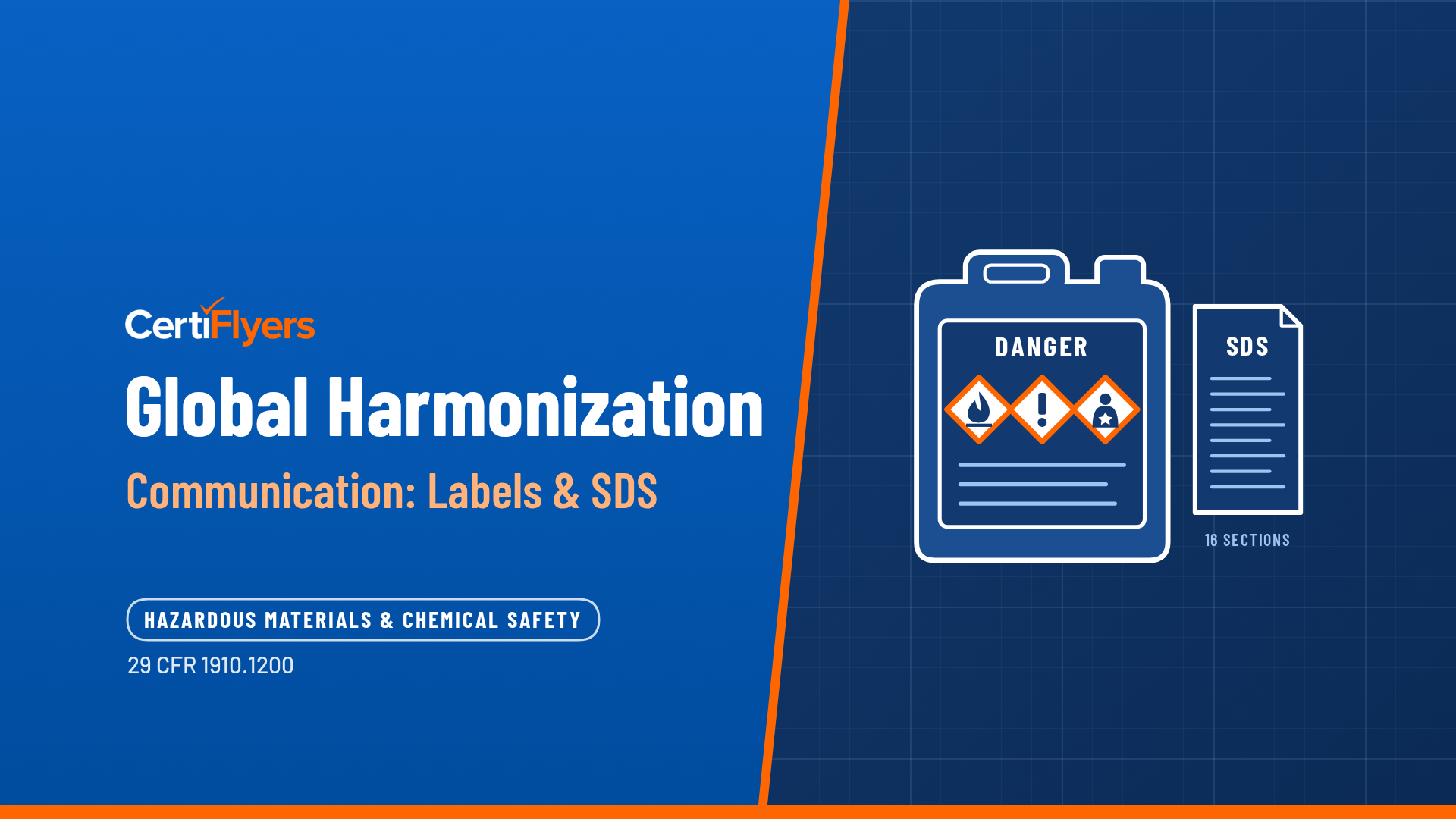
- The 16-section SDS Utilizing Safety Data Sheets (SDSs).
- Classify and control hazards Recognizing Physical and Health Hazards.
YOU'LL BE ABLE TO4 things, on the job
- Interpret GHS labels.
- Extract critical SDS information.
- Manage aviation chemical hazards.
- Match protection to hazard.
TEST YOURSELFA question from module 2
Before a routine cleaning task with a solvent new to the shop, a technician pulls its Safety Data Sheet from the binder. Where are the glove material and respirator found, and when do they go on?
A Section 8, with engineering controls set up and PPE on before the container is opened.
Right. Section 8 gives the Permissible Exposure Limits and the PPE to use, and the course sets up controls and dons PPE before opening the container.
B Section 4, once someone has been exposed.
Not quite. Section 4 holds first-aid measures for after an exposure; protective equipment is chosen from Section 8 before handling starts.
C Section 11, as soon as vapors are noticed during the task.
Not quite. Section 11 shows how a chemical could enter the body, but the PPE comes from Section 8 and goes on before the container is opened, not once exposure begins.
D Section 16, because the technical data comes last.
Not quite. Sections 9 to 16 hold technical and scientific data, while the information most useful to exposed workers, including PPE, sits in Sections 1 to 8.
Stuck? In the course, Crew Chief, your AI tutor, explains it.
HANGAR CARDUnlocks when you pass
Read the label and Section 8 before you open the container.
| Number | What it means |
|---|---|
| 1910.1200 | OSHA Hazard Communication Standard — (f) labels, (g) safety data sheets |
| 16 | SDS sections — 1–8 for workers and responders, 9–16 technical data |
| 4 · 5 · 6 | first aid · firefighting · accidental release — the emergency sections |
| 7 · 8 | handling and storage · exposure limits and PPE — before routine use |
| < 23 °C | flash point of Category 1 and 2 flammable liquids, such as acetone |
| ≤ 60 °C | flash point ceiling for Category 3 — diesel fuel, turpentine |
Unlocks when you pass this course
BUILT ONThe standards behind it
- 29 CFR 1910.1200(c)Definitions of physical and health hazards: chemicals classified under the criteria of Appendix B and Appendix A, used in Module 3.
- 29 CFR 1910.1200(f) and Appendix CLabels and other forms of warning on workplace containers, the exemption for portable containers for immediate use, and the allocation of label elements.
- 29 CFR 1910.1200(g) and Appendix DSafety data sheets: who obtains, develops and passes them on, employee access during the work shift, and the minimum information they contain.
- United Nations GHS (Rev. 7), Chapters 2.6 and 3.1Flammable-liquid categories by flash point and initial boiling point, and acute toxicity classification.
- Occupational Safety and Health Administration (OSHA) Briefs, Hazard Communication StandardLabels and Pictograms; Safety Data Sheets: Plain-language background on label elements and the 16-section SDS format.
QUESTIONSWhat technicians ask first
- Who is this course for?
- Maintenance technicians and mechanics working on all airframes and powerplants. It assumes general workplace safety knowledge and experience handling aircraft chemicals, solvents and fuels.
- Do I have to label a spray bottle I fill from a drum?
- The course rule is yes: never transfer a chemical into an unlabeled container, and give any secondary container the product identifier and general hazard information. 29 CFR 1910.1200(f) itself exempts portable containers for the immediate use of the employee who performs the transfer. Workplace systems such as the Hazardous Materials Identification System (HMIS) or National Fire Protection Association (NFPA) diamonds may be used on secondary containers, as long as they are consistent with Hazard Communication Standard definitions and convey the specific physical and health hazards.
- Which SDS sections do I need in a spill or an exposure?
- Go straight to Section 4 (First-Aid Measures), Section 5 (Firefighting Measures) or Section 6 (Accidental Release Measures), depending on the emergency. Sections 1 to 8 come first because they hold the information most useful to exposed workers and emergency responders.
- Where do I find the right gloves and respirator for a chemical?
- In Section 8, Exposure Controls/PPE, which gives the OSHA Permissible Exposure Limits (PELs) and the PPE to use, such as specific glove materials or respirators. Check it before routine handling, then set up engineering controls such as local exhaust ventilation and put on the PPE before opening the container.
- What do the flammable-liquid categories mean?
- Flammable liquids fall into four categories by flash point and initial boiling point, and a higher category number means lower severity. Category 1 (flash point below 23 °C/73.4 °F, initial boiling point at or below 35 °C/95 °F) is the most dangerous, and Category 4 (flash point above 60 °C/140 °F and up to 93 °C/199.4 °F) the least severe. Acetone and hexane are Category 2 examples, and diesel fuel and turpentine are Category 3.
- Who has to provide the SDS, and when must I be able to see it?
- Chemical manufacturers and importers obtain or develop an SDS for each hazardous chemical, and distributors pass it on. Your employer must keep SDSs readily accessible to employees during their work shift, for example in a designated binder or an electronic database.