Safety Management & Quality
Foreign Object Debris (FOD)
Clean as you go; no panel closes until everything is accounted for.
THE 3 MODULESOne at a time, video and slides
- Debris, damage and the Dirty Dozen Fundamentals of FOD and Human Factors.
- Prevention in the work zone FOD Prevention in the Maintenance Environment.
- Zone checks and FOD response Post-Maintenance Zone Verification and Incident Response.
YOU'LL BE ABLE TO4 things, on the job
- Define debris versus damage.
- Apply FOD prevention practices.
- Inspect by zone risk.
- Mitigate human factors.
TEST YOURSELFA question from module 2
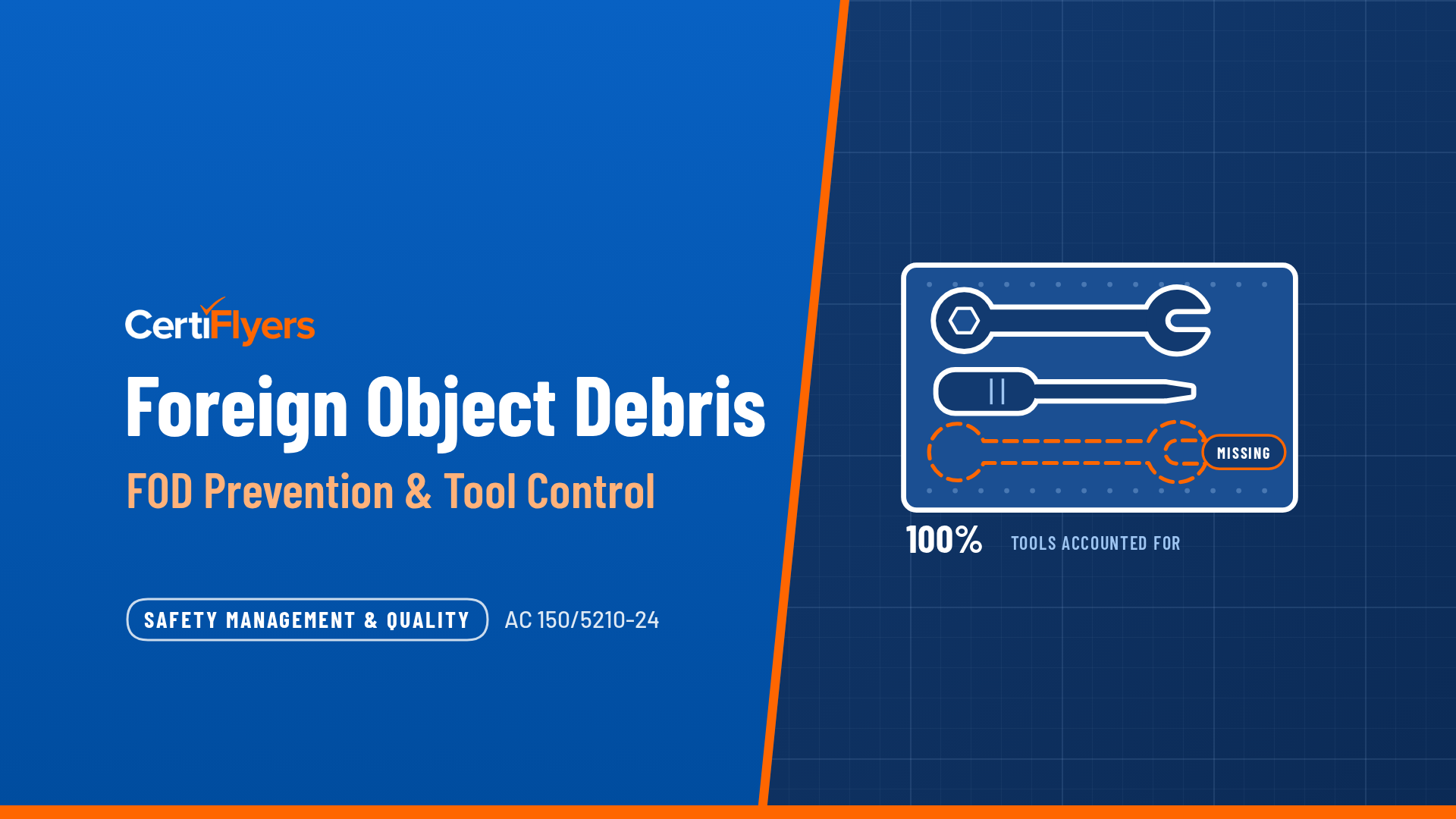
A technician finishes work behind an access panel. The shadow board is complete, but one cleaning rag brought into the zone cannot be found. What happens before the panel is closed?
A The panel stays open until the rag is found and 100% accountability is confirmed.
Right. The Pre-Closure Declaration requires 100% accountability of all tools, hardware and consumables, and no panel is closed until FOD clearance is verified.
B Close the panel, because only tools and hardware need to be accounted for.
Not quite. FOD is not limited to metal tools or hardware, and rags, wire clippings and packaging are all potential FOD hazards.
C Close the panel and record the missing rag on the work order.
Not quite. Recording the rag does not clear the zone, because any unaccounted item is a potential FOD hazard until proven otherwise.
D Close the panel if a quick look inside shows nothing loose.
Not quite. A quick look is not accountability, since every item brought into the maintenance zone must be tracked and accounted for.
Stuck? In the course, Crew Chief, your AI tutor, explains it.
HANGAR CARD · FREEThe pocket card that goes with it
Anything you can't account for is FOD until proven otherwise.
| Number | What it means |
|---|---|
| AS9146 | aerospace FOD prevention standard — tool and material accountability, Clean As You Go housekeeping |
| 150/5210-24A | FAA AC (2024): advisory guidance for airport FOD programs — prevention, detection, removal, evaluation |
| 100% | accountability of tools, hardware and consumables before any panel is sealed |
| 3 zones | Critical, Sensitive, Non-Critical — match the inspection method to the zone |
| 2017 | Metroliner — mechanic called away, screwdriver left in the wiper area |
| 109 + 4 | Concorde 2000 — perished aboard and on the ground; runway metal strip |
Before closing up: check
PANEL STAYS OPEN
BUILT ONThe standards behind it
- SAE AS9146The aerospace FOD prevention standard; the course uses its required processes for tool and material accountability and Clean As You Go housekeeping.
- FAA Advisory Circular 150/5210-24A, Airport FOD ManagementAdvisory guidance for airport FOD programs (prevention, detection, removal, evaluation); the course applies its evaluation element to FOD found during maintenance.
- Manufacturer maintenance manuals (Boeing, Airbus)Carry FOD prevention requirements for managing tools, hardware and consumables, which the course pairs with Clean As You Go discipline.
QUESTIONSWhat technicians ask first
- Who is this course for?
- Aircraft maintenance technicians (AMTs), aviation maintenance engineers (AMEs) and apprentice mechanics. It assumes basic AMT or AME licensing or an active apprenticeship, and standard-issue mechanic hand tools.
- What should a technician do when called away in the middle of a task?
- Physically remove all tools from the aircraft component and secure them before leaving. In the 2017 Western Airlines Metroliner incident at Boise, a mechanic who was called away left a screwdriver in the windshield wiper area on the nose, and it caused substantial damage on a pre-dawn takeoff.
- What if an item cannot be accounted for before an access panel is closed?
- The panel stays open. The pre-closure declaration needs 100% accountability of all tools, hardware and consumables, and no panel is closed until FOD clearance is verified. Any unaccounted item is a potential FOD hazard until proven otherwise.
- How do post-maintenance checks differ by zone?
- Non-Critical Zones, such as the passenger cabin and external fairings that enclose no mechanisms or systems, get basic visual inspections and standard sweeping or vacuuming. Sensitive Zones, such as wheel wells and secondary control surfaces, get enhanced visual inspections, magnetic sweeps and a final tool accounting. Critical Zones, such as engine bays and flight control mechanisms, get borescope exams of internal cavities, torque seal audits after engine work and step-by-step checklists for fastener integrity.
- What happens when FOD is found during maintenance?
- Halt all maintenance activities at once, and do not remove the object unless it poses an immediate safety hazard. Notify the shift supervisor immediately, then record the exact location, the discovery method and the nature of the part before any corrective action. No work continues until the object is identified, documented and the zone is cleared.
- What does AS9146 require, and where do shadow boards fit?
- AS9146 requires processes for tool and material accountability and Clean As You Go housekeeping, to prevent foreign objects from entering aircraft systems. Shadow boards and spill-proof totes are common ways of meeting it, and the course's Control Your Materials step uses them together with magnetic mats.