Safety Management & Quality
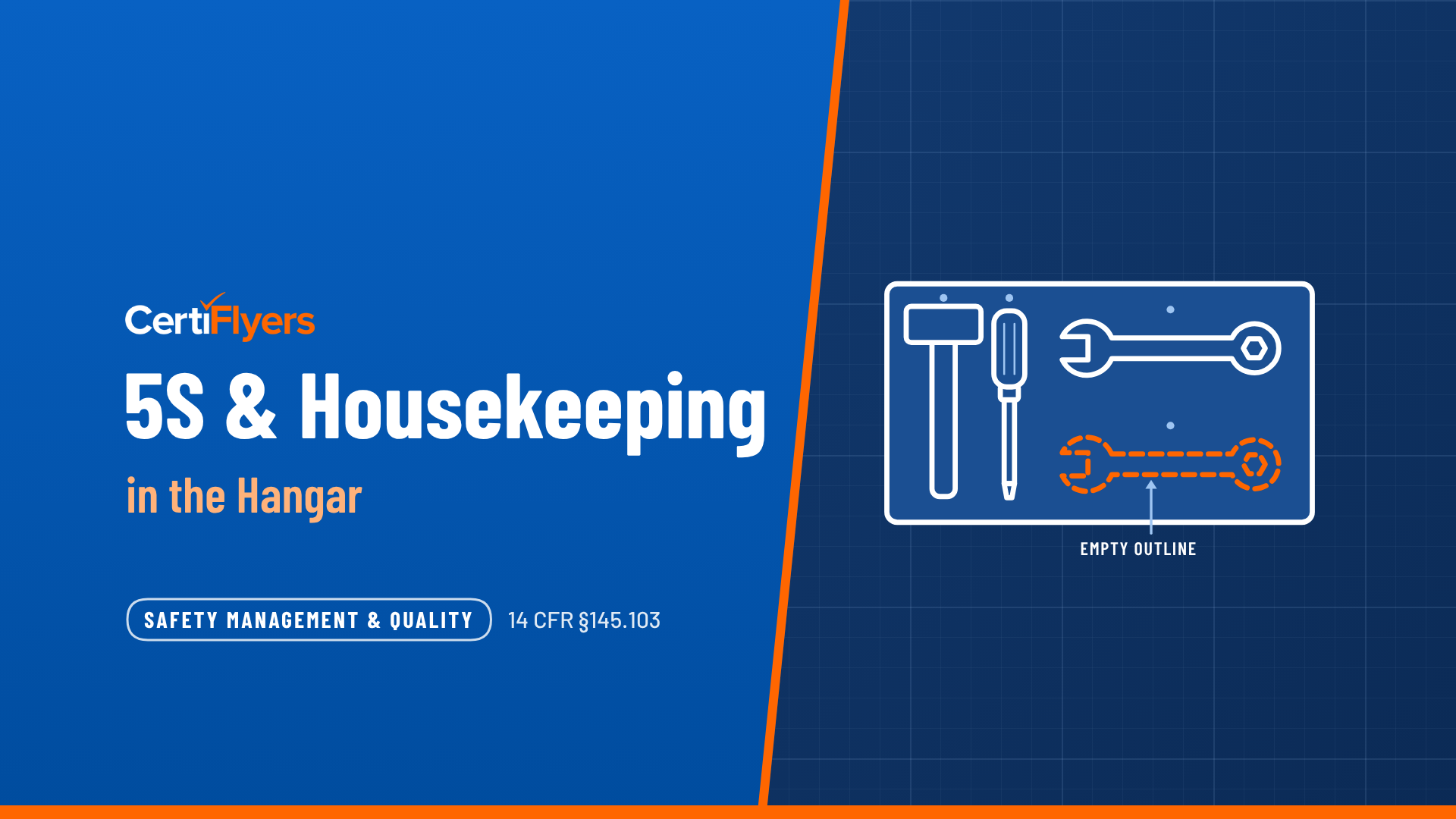
5S and Housekeeping in the Hangar
Every item has a home, and nothing is left behind.
THE 4 MODULESOne at a time, video and slides
- Foundations, Sort and Set in order 5S Foundations: Sort and Set in Order.
- Shine: clean as you go Shine: Clean as You Go and Inspect.
- Standardize: the end-of-task check Standardize: The End-of-Task and End-of-Shift Check.
- Sustain: audits and reporting Sustain: Audits, Reporting and Equipment Beyond the Hangar.
YOU'LL BE ABLE TO4 things, on the job
- Separate rules from method.
- Sort and label items.
- Clean as an inspection.
- Complete the end-of-task check.
TEST YOURSELFA question from module 3
At the end of a task, a technician cannot find a rag that was used inside an access panel. The aircraft is due out in ten minutes. What should the technician do?
A Close the panel, because a rag is a consumable, not a tool.
Not quite. Consumables are items too, and a rag trapped in a Boeing 737-838 trim cable drum compromised the integrity of the manual trim control.
B Take a new rag from the dispenser so the count matches.
Not quite. Replacing the rag hides the problem, because the missing rag may still be inside the aircraft.
C Stop, do not close the zone or release the aircraft, and report to the supervisor.
Right. If any item cannot be accounted for, the job stops and the lost-item procedure is followed; for European Union Aviation Safety Agency (EASA) Part-145 organizations, point 145.A.48(c)(1) requires the aircraft to be clear of extraneous material.
D Release the aircraft on time and mention the rag at shift handover.
Not quite. The course says the aircraft is not released while any item is unaccounted for.
Stuck? In the course, Crew Chief, your AI tutor, explains it.
HANGAR CARDUnlocks when you pass
Every item has a home, and nothing is left behind.
| Number | What it means |
|---|---|
| five-minute | Daily check of each zone by the area owner |
| §145.103 | 14 CFR repair station rule: segregate and protect articles |
| 145.A.48 | EASA point requiring the general verification after maintenance |
| §1910.22 | 29 CFR rule: clean, orderly surfaces; spills corrected or guarded |
| §1910.176(c) | 29 CFR paragraph titled Housekeeping: storage areas free of hazards |
| 37 minutes | Time a fallen step ladder lay on an active runway |
Unlocks when you pass this course
BUILT ONThe standards behind it
- 14 CFR §145.103(a)(2)Space, racks, trays, stands and other segregation means to segregate and protect articles, with stock for installation kept apart from articles under maintenance.
- EASA Part-145 points 145.A.25, 145.A.42(c) and 145.A.48(c)(1)Facility, dust and storage outcomes, segregation of unserviceable components, and the general verification that the aircraft is clear of tools and extraneous parts or material.
- 29 CFR §1910.22 and §1910.176(c)Clean, orderly and, to the extent feasible, dry surfaces; spills corrected or guarded; and the paragraph titled Housekeeping for storage areas.
- 29 CFR §1910.37(a)(3), §1910.303(g)(1)(ii) and §1910.1200(f)(6)Exit routes kept free, no storage in electrical working space, and labeled hazardous chemical containers.
- FAA AC 145-10 and AC 150/5210-24A (guidance, not regulation)AC 145-10 does not mention 5S; AC 150/5210-24A defines clean-as-you-go and names checklists, shadow boards and tool accounting as control aids.
- US EPA Lean Thinking and Methods5S (good-practice method): The public definition of the five pillars and red-tag sorting; a good-practice source, not a regulation.
QUESTIONSWhat technicians ask first
Who is this course for?
All hangar and back-shop staff: technicians, inspectors, apprentices, stores, cleaning and facility staff, ground support equipment (GSE) operators and supervisors. Company induction is the only prerequisite. Knowing the company tool control procedure and having had hazard communication (HazCom) training helps, but this course replaces neither.
Do aviation regulators require us to use 5S?
No. No Federal Aviation Administration (FAA) or European Union Aviation Safety Agency (EASA) rule covered in the course names 5S, and a review of FAA Advisory Circular (AC) 145-10 found no mention of it. The rules set outcomes such as segregated articles, secure storage, clean surfaces and, for EASA Part-145 organizations, a general verification after maintenance; 5S is a good-practice method for meeting them.
Can I throw away an aircraft part or bolt I find during Sort?
No. Aircraft parts, hardware and components are never red-tagged or discarded during Sort; they go to stores and inspection so their status segregation is kept. A part found on the floor may be missing from an aircraft, so it is bagged, labeled with where it was found and reported.
Is a 5S red tag the same as an unserviceable or condemned tag?
No. A 5S red tag is a sorting label for an item pending a holding-area decision; it is not a part status tag and not an Occupational Safety and Health Administration (OSHA) danger tag. The course asks for distinct designs, because misread tags contributed to the ValuJet Flight 592 accident.
What if there is a spill I cannot clean up right away?
Guard the area so that no one uses the surface until the hazard is corrected, as 29 CFR §1910.22(d)(2) requires, and report it. Then clean it up using the absorbent and disposal route in the safety data sheet and the company procedure.
Do US repair station rules have the same end-of-task requirement as Part-145?
European Union Aviation Safety Agency (EASA) Part-145 point 145.A.48(c)(1) requires a general verification that the aircraft or component is clear of all tools, equipment and extraneous parts or material. No equivalent sentence was found in 14 CFR §145.103, §145.109, §145.163 or §43.13. For Federal Aviation Administration (FAA) repair stations, the check is good practice set in company procedures.
Red-Tag or Not?
12 cards from the course, about 4 minutes. A taste of the lesson before you start.