Human Factors & Professional Skills
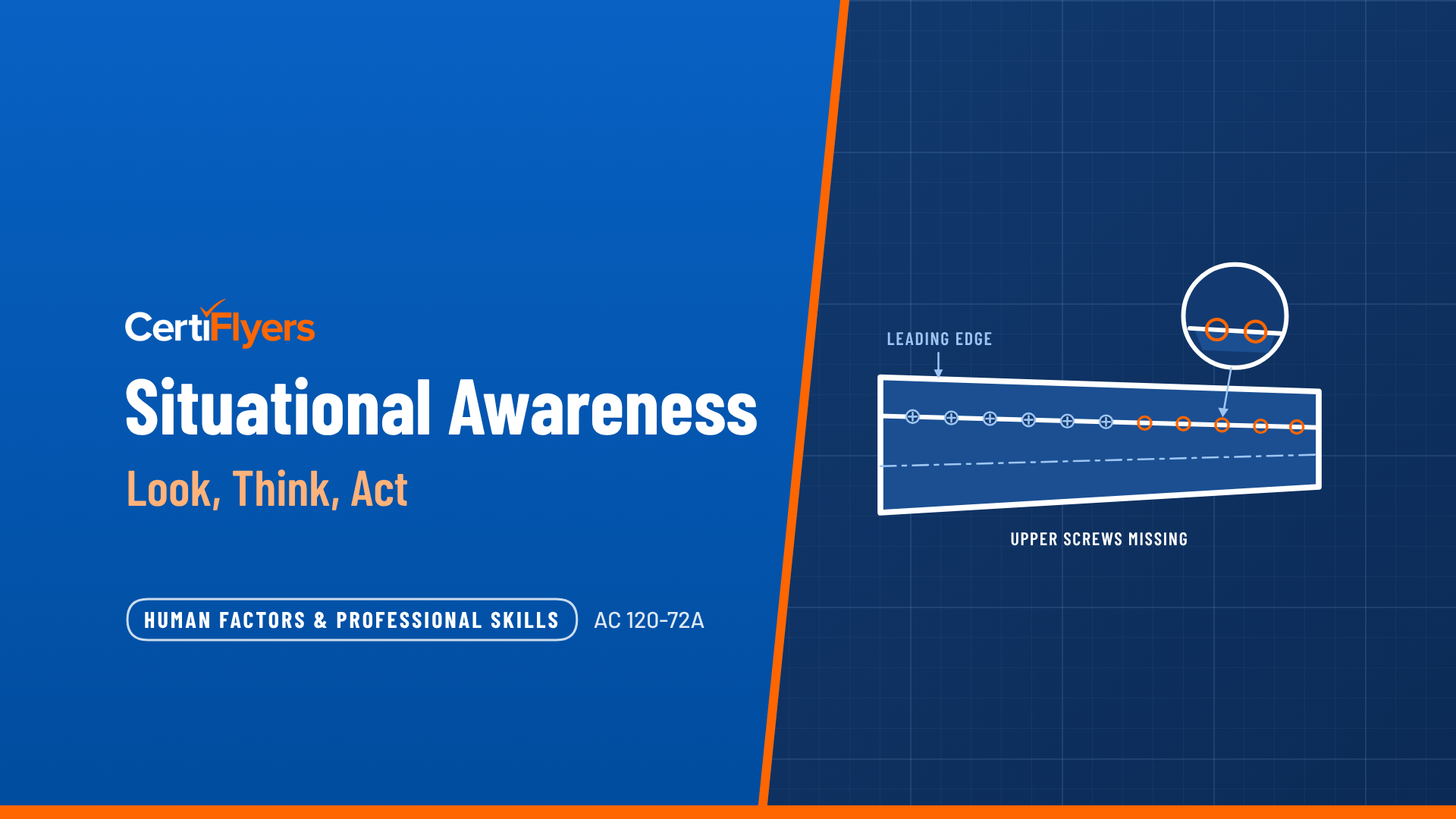
Situational Awareness — Look, Think, Act
Look, think, act: a cue you cannot explain is a stop point.
THE 5 MODULESOne at a time, video and slides
- What situational awareness is What Situational Awareness Is: Look, Think, Act.
- Seeing the item, checking the data Look and Think: Seeing the Item, Checking the Data.
- Keeping the picture across shifts Keeping the Picture Across People and Shifts.
- Restoring and proving disturbed systems Act: Restoring and Proving Every Disturbed System.
- Projecting hazards during engine runs Act: Projecting Hazards to People During Engine Runs.
YOU'LL BE ABLE TO4 things, on the job
- Explain the three levels.
- Verify against maintenance data.
- Deliver a complete handover.
- Restore and prove systems.
TEST YOURSELFA question from module 2
During an inspection in good light, you find a collar fitted on a spoiler actuator. It is not on your task card, and you cannot explain why it is there. What should you do?
A Stop and check it against this type's maintenance manual before continuing.
Right. The course rule is that a cue you cannot explain is a stop point, and the answer comes from the aircraft maintenance manual for this type, not from memory.
B Continue, assuming the previous shift had a good reason to fit it.
Not quite. Explaining a cue away with the wrong mental model is the typical failure at the Think level.
C Remove it, because a similar type you know well does not use one.
Not quite. The course says never to rely on how another aircraft type works; on G-KMAM, familiarity with other types contributed to the spoilers being left in maintenance mode.
D Note it on the task card and finish the inspection before asking.
Not quite. The course says not to continue until the maintenance data explains the cue.
Stuck? In the course, Crew Chief, your AI tutor, explains it.
HANGAR CARDUnlocks when you pass
Check the aircraft itself against the manual, then prove every disturbed system.
| Number | What it means |
|---|---|
| 3 steps | Go back this far when restarting after any interruption |
| 9-foot | Inlet zone radius for that Boeing 737 only (NTSB DFW06FA056); use your type's data |
| 20 to 30 | Minutes of shift overlap Civil Aviation Publication 716 calls good practice |
| 145.A.47(c) | European Union Part-145 point requiring handover information be communicated |
| §43.13(a) | 14 CFR: work to the manufacturer's data or other acceptable methods |
| twelve | Common maintenance error causes in Advisory Circular 120-72A, paragraph 5.5 |
Unlocks when you pass this course
BUILT ONThe standards behind it
- Federal Aviation Administration (FAA) Advisory Circular (AC) 120-72A, Maintenance Human Factors Training, paragraph 5.5Guidance listing Lack of Awareness and Distraction among the twelve most common maintenance-related causes of errors; the course's starting point.
- Title 14 Code of Federal Regulations (14 CFR) §43.13(a), Performance rules (general)Rule that maintenance uses the methods in the current manufacturer's maintenance manual or Instructions for Continued Airworthiness, or other methods acceptable to the Administrator; the basis for checking items against data and performing required functional checks.
- Commission Regulation (EU) No 1321/2014, Annex II (Part-145), point 145.A.47(c)Rule requiring relevant information to be adequately communicated between outgoing and incoming personnel when a task continues across a shift or personnel change.
- European Union Aviation Safety Agency (EASA) Guidance Material (GM1) 145.A.30(e), item 4.5Guidance material listing situational awareness as a human factors safety training topic.
- UK Civil Aviation Authority Civil Aviation Publication (CAP) 715, Chapter 1 and Chapter 2Guidance on perception, expectation, mental models and interruptions, and factors common to United Kingdom maintenance incidents.
- UK Civil Aviation Authority Civil Aviation Publication (CAP) 716, Chapter 7, section 2Guidance on effective handover: its three elements, the written and verbal belt and braces approach, and shift overlap.
QUESTIONSWhat technicians ask first
Who is this course for?
It is for all maintenance staff whose work or presence affects an aircraft's state: technicians, licensed engineers, inspectors, apprentices, trainees, supervisors, shift leads and support staff who move, tow, service or run aircraft. The course is awareness-level and practical, and it assumes no prior human factors training.
What does "go back three steps" mean after an interruption?
It is the Federal Aviation Administration (FAA) Dirty Dozen safety net for restarting work. After any interruption, go back three steps and re-check the task status on the card and on the aircraft. Then resume from where the task actually is, not from where you think it was.
What should a written handover record?
It records each item removed, disconnected, isolated or in a maintenance mode, where it is and how many, plus every restorative step still open in the aircraft maintenance manual (AMM) task. Name each item; never write or say "back to normal state". Then brief the written status face to face, at the aircraft where possible, including when a task passes to another person within one shift.
Do United States regulations require a shift turnover procedure?
The research for this course found no section of Title 14 of the Code of Federal Regulations (14 CFR) that names shift turnover. For Federal Aviation Administration (FAA) certificate holders, the turnover procedure is in the approved or accepted manual, and following it is a manual requirement. On Continental Express Flight 2574, the National Transportation Safety Board (NTSB) found the general lack of compliance with the procedures of the approved General Maintenance Manual directly causal.
Why is seeing a flight control move not enough after reconnecting it?
Movement alone does not prove correct connection; on Embraer 190 P4-KCJ, aileron cables reconnected inverted in both wings were not detected. Confirm surface direction and response against each input in the test the manual requires, using the synoptic page where the manual allows. Any reversed, absent or unexpected response is a no-go.
How do I know how large an engine hazard zone is?
Take the inlet and exhaust hazard zones for the aircraft type and each planned power setting from that type's own maintenance data before every run. The 9-foot inlet radius recorded in National Transportation Safety Board (NTSB) report DFW06FA056 applies to the Boeing 737 involved, not to every type. A clearance call such as "all clear" confirms that no one is in a hazard zone only at the moment it is made.
Look, Think or Act?
10 cards from the course, about 4 minutes. A taste of the lesson before you start.