Safety Management & Quality
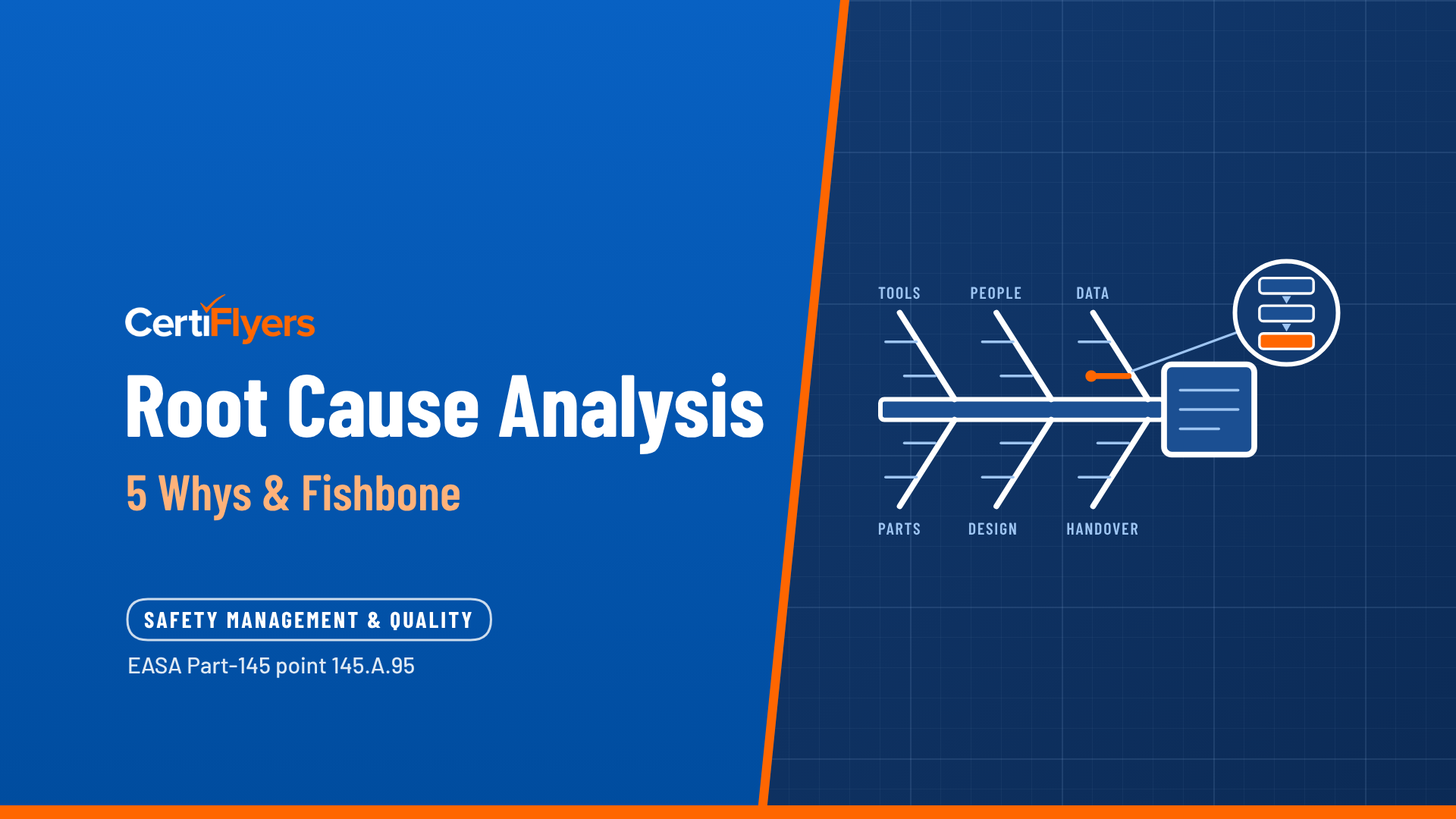
Root Cause Analysis — 5 Whys and Fishbone
Stop at a cause your organization can fix, never at a person.
THE 4 MODULESOne at a time, video and slides
- Symptom or cause? Symptom or Cause?
- The 5 Whys The 5 Whys: Drilling Down, Branching, Avoiding Blame.
- The maintenance fishbone Mapping Contributing Factors with a Maintenance Fishbone.
- Verify, stop and state Verifying Causes and Stopping Where the Organization Can Act.
YOU'LL BE ABLE TO4 things, on the job
- Write problem statements.
- Run a 5 Whys.
- Build a maintenance fishbone.
- Verify and state causes.
TEST YOURSELFA question from module 4
Four wheel assemblies were torqued to a value from a superseded manual revision. The draft analysis ends: "Root cause: technician complacency. Action: retrain the technician." What should the supervisor do?
A Accept it, because the technician admitted the mistake.
Not quite. An admission does not turn a label into a root cause, and retraining one person leaves the trap in place for the next technician.
B Keep asking why: find what let the old revision reach the bench and why inspection did not catch it.
Right. The course's stop-point test treats complacency as a no-go label: keep asking until you reach a system condition the organization controls.
C Add a written warning to the technician's file and close the finding.
Not quite. Blame does not change the system that let superseded data reach the bench, so the same error can recur.
D Close the finding once the four assemblies are re-torqued.
Not quite. Re-torquing is a correction; the corrective action must eliminate or mitigate the root cause so the problem does not recur.
Stuck? In the course, Crew Chief, your AI tutor, explains it.
HANGAR CARDUnlocks when you pass
Stop at a cause your organization can fix, never at a person.
| Number | What it means |
|---|---|
| 145.A.95 | Part-145 point: root causes and contributing factors of authority findings |
| 145.A.202 | Part-145 point: causes of internally reported errors, near misses, hazards |
| §145.211 | 14 CFR repair station rule: corrective action on deficiencies |
| 120-79A | Advisory circular accepting the 5 Whys; guidance, not mandatory |
| 10 to 15 | Write-ups a Chalk's 101 captain said one fuel leak sometimes took (FAA summary) |
| 47 | Upper screws never reinstalled at Continental Express Flight 2574 |
Unlocks when you pass this course
BUILT ONThe standards behind it
- EASA Part-145 point 145.A.95Requires root cause(s) and contributing factor(s) of authority findings to be identified, a corrective action plan defined and its implementation demonstrated.
- EASA Part-145 point 145.A.202Requires the causes of, and contributing factors to, internally reported errors, near misses and hazards to be identified.
- 14 CFR §145.211 and 14 CFR §121.373Require repair station procedures for corrective action on deficiencies, and Part 121 carrier analysis and correction of maintenance program deficiencies, including contract work.
- FAA AC 120-79A and AC 00-58CGuidance, not regulation: the 5 Whys as a valid approach, errors as system defects, and the voluntary disclosure comprehensive fix with an effectiveness audit.
- ICAO Doc 9859Guidance: stopping an investigation at the first viable cause is a safety-culture disabler.
- IAQG 9110/9100 clause 10.2Certification standards for nonconformity and corrective action, binding only on certified organizations; paraphrased, never quoted.
QUESTIONSWhat technicians ask first
Who is this course for?
Supervisors, lead technicians, inspectors and quality staff in Federal Aviation Administration (FAA) Part 145 repair stations, European Union Aviation Safety Agency (EASA) Part-145 organizations and air carrier maintenance departments. It suits anyone who answers audit findings, customer corrective-action requests or internal safety reports.
Does the Federal Aviation Administration (FAA) require my repair station to do root cause analysis?
Not in those words. 14 CFR §145.211(c)(1) requires quality control manual procedures for "Taking corrective action on deficiencies" but does not use the words "root cause". Under 14 CFR §121.373, Part 121 carriers must correct deficiencies in work that contract repair stations perform for them, and the Voluntary Disclosure Reporting Program makes root cause analysis a condition of disclosure.
Does it have to be exactly five whys?
No. Five is a guide, not a rule. Stop when the answer passes the stop-point test: supported by evidence, a condition of the system, within the organization's control, and able to prevent recurrence with a corrective action whose effectiveness can be checked.
Why can't "human error" be the root cause?
Because it describes what happened, not why. Federal Aviation Administration Advisory Circular 120-79A treats errors as defects in the system rather than in an individual. Ask what made the error possible, likely or undetected; reckless or intentional acts are still handled under the organization's just culture policy.
Is the 5 Whys enough for an authority finding?
Often not alone. European Union Aviation Safety Agency guidance cautions that a simple, linear analysis can lead to quick fixes that treat only symptoms. For authority findings, safety reports and airworthiness issues, widen first with a fishbone, run a 5 Whys on each supported branch, allow several root causes and get a peer review.
Can a finding have more than one root cause?
Yes. European Union Aviation Safety Agency (EASA) Part-145 point 145.A.95 is written "root cause(s)", and the Voluntary Disclosure Reporting Program report has room for up to five root causes. Write one statement per root cause and list contributing factors separately.
Fix the Root Cause Record
8 errors from the course, about 5 minutes. A taste of the lesson before you start.