Safety Management & Quality
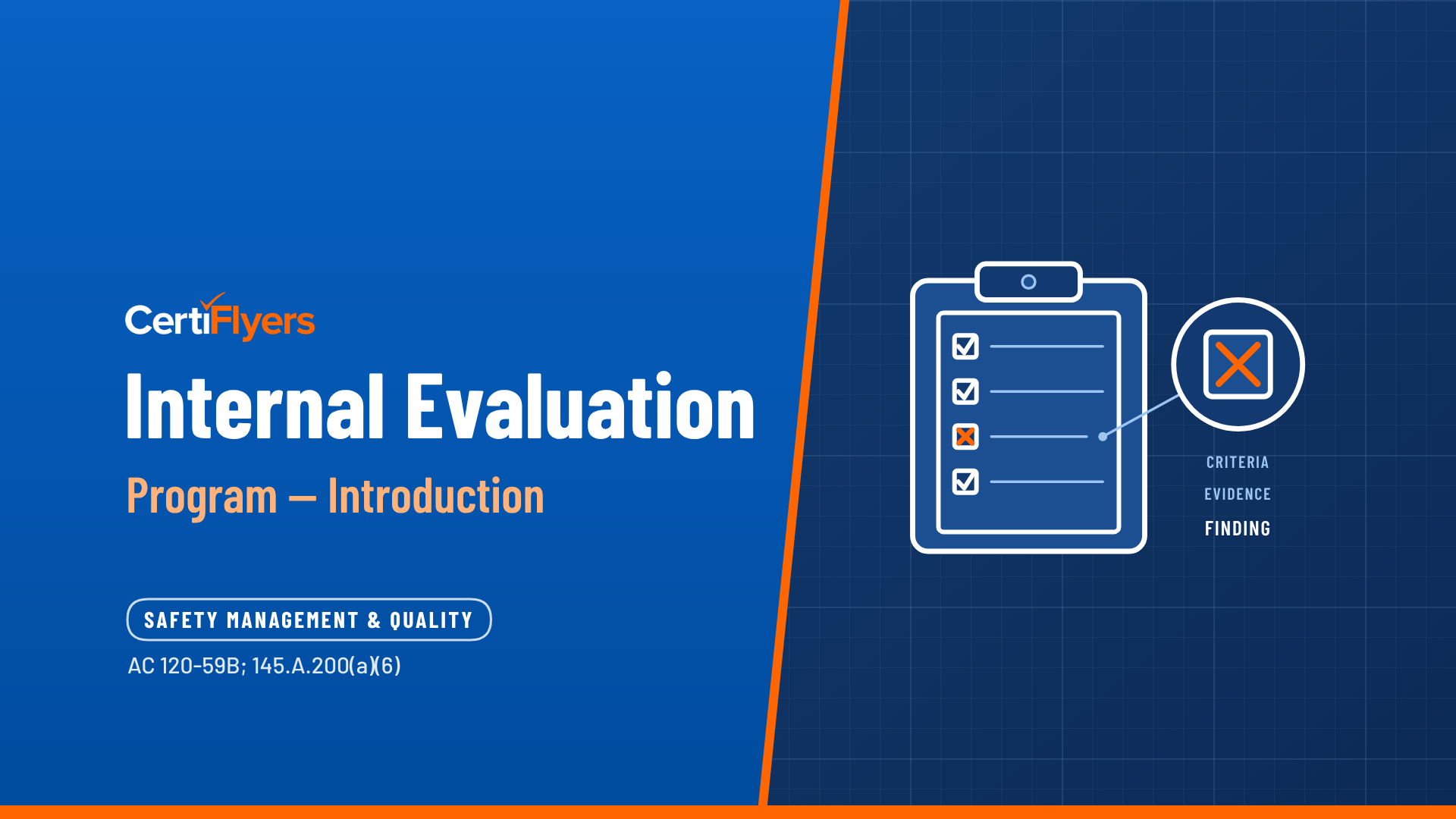
Internal Evaluation Program — Introduction
Never audit your own work; close a finding only on evidence.
THE 4 MODULESOne at a time, video and slides
- Why audit yourself Why Audit Yourself: Requirement, Guidance and Safety Assurance.
- Independence, scope and audit plan Building the Program: Independence, Scope, Standards and Plan.
- Evidence, sampling and findings Performing an Evaluation: Evidence, Sampling and Findings.
- Root cause to verified fix Closing the Loop: Root Cause to Verified Fix.
YOU'LL BE ABLE TO4 things, on the job
- Separate rule from guidance.
- Build an independent plan.
- Evaluate and write findings.
- Close findings on evidence.
TEST YOURSELFA question from module 2
Your quality team is scheduling next month's audits. The engine shop's lead inspector wrote the shop's torque procedure and inspects its work daily. Who should audit the engine shop?
A The engine shop lead inspector, who knows the procedure best
Not quite. Task independence means no one audits a procedure they wrote or work they performed or inspected.
B An evaluator who has no role in the engine shop's work
Right. Under European Union Aviation Safety Agency (EASA) Acceptable Means of Compliance (AMC) AMC1 145.A.200(a)(6), auditors are not responsible for the functions, procedures or products they audit.
C The engine shop supervisor, who oversees the shop's daily work
Not quite. Task independence means no one audits an area they supervise.
D A technician the engine shop manager selects from the shop
Not quite. The course states that no auditor is assigned to an area they work in, and that the program reports to senior management rather than to the manager whose area is evaluated.
Stuck? In the course, Crew Chief, your AI tutor, explains it.
HANGAR CARDUnlocks when you pass
Ground the aircraft first; close a finding only on verified evidence.
| Number | What it means |
|---|---|
| three years | Maximum audit cycle for every area, AC 120-59B paragraph 9.5 |
| two years | Maximum period between audits of a line station, European Part-145 organizations |
| 24 hours | Latest initial disclosure notification after detection, AC 00-58C paragraph 8.2 |
| five | Elements a corrective action plan should hold, AC 120-59B paragraph 9.6.1 |
| half-yearly | Minimum compliance monitoring summary to the accountable manager, European Part-145 |
| AC 120-59B | Advisory Circular on Internal Evaluation Programs; guidance, not a rule |
Unlocks when you pass this course
BUILT ONThe standards behind it
- AC 120-59B, Internal Evaluation ProgramsGuidance on independence, scope, standards, the three-year cycle, findings and corrective action plans; paragraph 1.1 states that no regulation requires an Internal Evaluation Program.
- EASA Part-145 point 145.A.200(a)(6), with AMC1 to AMC4 and GM1 to GM2The compliance monitoring rule for European Part-145 organizations; its acceptable means of compliance set the annual audit plan, auditor independence, product audits and escalation of overdue actions.
- 14 CFR §5.71, Safety performance monitoring and measurementRequires auditing and evaluations for safety management system holders; Part 135 operators must implement by 28 May 2027, and the 2024 final rule does not cover Part 145 repair stations.
- 14 CFR §121.373, Continuing analysis and surveillanceRequires a Part 121 certificate holder to maintain a Continuing Analysis and Surveillance System, for which an Internal Evaluation Program is not a substitute.
- 14 CFR §145.211, Quality control systemParagraph (c)(1)(ix) requires quality control procedures for taking corrective action on deficiencies, the requirement on which a repair station's Internal Evaluation Program is built as good practice.
- AC 00-58C, Voluntary Disclosure Reporting ProgramParagraph 8.2 states that a disclosure is acceptable only if immediate action terminated the conduct, with initial notification no later than 24 hours after detection.
QUESTIONSWhat technicians ask first
Who is this course for?
This course is for quality managers, compliance monitoring managers, internal evaluators and auditors, inspectors with audit duties, and supervisors who answer findings with a corrective action plan. It applies to Federal Aviation Administration (FAA) Part 145 repair stations, Part 121 and Part 135 air carriers, and European Union Aviation Safety Agency (EASA) Part-145 approved maintenance organizations. There is no formal prerequisite, but you should know your organization's manuals, maintenance record entries, return to service, and Title 14 of the Code of Federal Regulations (14 CFR) Parts 43 and 145 or EASA Part-145.
Does a regulation require my repair station to have an Internal Evaluation Program?
Advisory Circular (AC) 120-59B, paragraph 1.1, states that there is no regulatory requirement for an Internal Evaluation Program, and paragraph 8.8.1 states that the Federal Aviation Administration (FAA) does not approve or accept one. Title 14 of the Code of Federal Regulations (14 CFR) §145.211(c)(1)(ix) does require quality control procedures for taking corrective action on deficiencies, and the course treats an Internal Evaluation Program as good practice built on that requirement. If the station also holds a European Union Aviation Safety Agency (EASA) Part-145 approval, point 145.A.200(a)(6) makes compliance monitoring a rule.
How often must each area be audited?
Under European Union Aviation Safety Agency (EASA) Acceptable Means of Compliance (AMC) AMC2 145.A.200(a)(6), every aspect of Part-145 compliance is verified every year and each line station at least every two years, with audits twice yearly if the audit is contracted. Advisory Circular (AC) 120-59B, paragraph 9.5, limits the cycle to three years. A dual-approved station uses the stricter cycle, and the course has you weight the schedule by risk and keep room for special and follow-up evaluations.
Can our inspectors audit the shop where they work?
An inspector should not audit their own area, because task independence means no one audits a procedure they wrote, work they performed or inspected, or an area they supervise. European Union Aviation Safety Agency (EASA) Acceptable Means of Compliance (AMC) AMC1 145.A.200(a)(6) expects auditors not to be responsible for the functions, procedures or products they audit, and the course has you record the independence check on the audit plan. Under AMC2 145.A.200(a)(6), paragraph (l), an organization with a maximum of 10 maintenance staff may contract the independent audit with the competent authority's agreement.
What should I do if an audit finds an aircraft that may be unairworthy?
Notify the person with authority to stop the release or ground the aircraft immediately, before you write any report. Report a regulatory noncompliance to the accountable manager the same day; management decides on disclosure, and a disclosure does not make continued operation legal. In the Southwest Airlines case the course studies, 46 Boeing 737 airplanes kept flying for eight days after the missed inspections were discovered.
When can a finding be closed?
A finding closes only on evidence that the corrective action was implemented and worked, never on the department's statement. A follow-up evaluation samples work produced after the corrective action, as Advisory Circular (AC) 120-59B, paragraph 9.4.3, provides. An action of "individual retrained" alone treats a symptom, and a recurring finding reopens the root cause analysis.
Fix This Finding
5 errors from the course, about 4 minutes. A taste of the lesson before you start.